Antarctic tern
A non-migratory southern tern with six recognized subspecies.

Wikipedia / Wikimedia Commons
The Antarctic tern (Sterna vittata) is a seabird in the family Laridae, found throughout the southern oceans on small islands around Antarctica and on the mainland shores. It is notable for its close resemblance to the Arctic tern, from which it differs by its stockier build and breeding plumage in the southern summer, and for its non-migratory behavior despite a very large range.
- Scientific name
- Sterna vittata
- Family
- Laridae
- Length
- 35–40 cm (14–16 in)
- Wingspan
- 74–79 cm (29–31 in)
- Weight
- 150–180 g (5.3–6.3 oz)
- Global population
- ~140,000 individuals
- IUCN status
- Least concern
Lore & Background
The Antarctic tern was formally described in 1789 by German naturalist Johann Friedrich Gmelin in his expanded edition of Carl Linnaeus's Systema Naturae, based on the 'wreathed tern' described by English ornithologist John Latham in 1785. Latham had received a specimen from naturalist Joseph Banks, mistakenly thought to be from Christmas Island but actually collected at Christmas Harbour in the Kerguelen Islands during James Cook's third voyage. The genus name Sterna comes from the Old English word for a black tern, and the specific epithet vittata is from Latin meaning 'banded'.
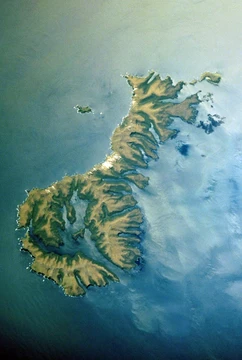
There are six recognized subspecies, each with specific breeding sites: S. v. tristanensis (Tristan da Cunha & Gough Island), S. v. sanctipauli (St. Paul & Amsterdam Islands), S. v. georgiae (South Georgia, South Orkney & South Sandwich Islands), S. v. gaini (South Shetland Islands, Antarctic Peninsula & nearby islands), S. v. vittata (Prince Edward, Crozet, Kerguelen, Bouvet & Heard Islands), and S. v. bethunei (Stewart, Snares, Auckland, Bounty, Antipodes, Campbell & Macquarie Islands). Terns are in the family Laridae along with gulls and skimmers, and the Antarctic tern is in the genus Sterna, which has been claimed to be monophyletic, though this has been challenged by a genetic study.
The Antarctic tern is a medium-sized tern with light grey body and wings in breeding plumage, a deeply forked white tail, a black cap, and bright red bill, legs, and feet. In non-breeding plumage, the black cap is reduced, underparts become lighter, and the bill becomes dull reddish-black. Juveniles have yellowish-brown, grey, and white spots. It closely resembles the Arctic tern but has longer legs and less prominent black margins on primary feathers. The white-fronted tern is also similar but larger and lighter with a longer black bill.
Reader's Guide
The Antarctic tern is significant as a widespread seabird of the southern oceans, demonstrating adaptation to sub-Antarctic and Antarctic environments without undertaking long migrations like its northern relative. Its six subspecies reflect geographic isolation on specific island groups, offering insights into avian speciation and biogeography. The species is classified as least concern by the IUCN, with a stable global population estimated between 132,000 and 145,000 individuals, though reproduction failures on some islands due to introduced mammalian predators like cats and rats highlight conservation challenges. Its diet of small fish and crustaceans, gregarious fishing behavior, and nesting in loose colonies on cliffs or rocky beaches contribute to its ecological role. The Antarctic tern's life expectancy of about 17 years and reproductive span of about 10 years, with breeding starting at age 3, provide a model for life-history studies. Its vocalizations, including a main call 'trr-trr-kriah' and a defensive 'chrrrr', are part of its behavioral repertoire. The species' presence on newly ice-free terrain in the north-eastern Antarctic Peninsula indicates potential responses to climate change. Overall, the Antarctic tern exemplifies the diversity and resilience of seabirds in extreme southern latitudes.
Did You Know?
- The Antarctic tern does not migrate like the Arctic tern, but it can still be found on a very large range.
- Its primary predators are gulls, skuas, and jaegers, which feed on its eggs and young.
- The total global population of the Antarctic tern is around 140,000 individuals.
- The specific epithet vittata is from Latin meaning 'banded'.
More in Birds of subantarctic islands 1-24
Spotted an error? Know more?
This is a living reference — every entry is fact-audited, and reader corrections feed straight into our audit queue. Suggest an edit · See this site's audit record