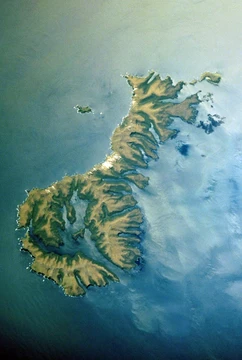
Common diving petrel
A small diving petrel of southern oceans.
The common diving petrel (Pelecanoides urinatrix) is a small, plump seabird that resembles an auk and lives in the southern oceans. It is one of four very similar diving petrel species. This bird is native to islands in the South Atlantic, the subantarctic Indian Ocean, waters off New Zealand, and islands near southeastern Australia.
German naturalist Johann Reinhold Forster first described the species in 1777, placing it in the genus *Procellaria* and naming it *Procellaria tridactyla*. English ornithologist John Latham later described the "diving petrel" in 1785, noting large numbers in Queen Charlotte Sound, New Zealand. Today, the common diving petrel belongs to the genus *Pelecanoides*, introduced in 1799 by French naturalist Bernard Germain de Lacépède. The genus name means "pelican-resembling," referring to the expandable throat pouches these birds use to carry food. The species name *urinatrix* comes from the Latin *urinator*, meaning "diver." There are six subspecies, which differ in body size, especially bill length. Their names reflect locations or people: *chathamensis* (Chatham Islands), *exsul* (meaning "isolated"), *dacunhae* (Tristan da Cunha), *berard* (after French navigator Auguste Bérard), and *coppingeri* (after Royal Navy surgeon Richard William Coppinger). The subspecies are: *P. u. urinatrix* (Australia, Tasmania, North Island New Zealand); *P. u. chathamensis* (Stewart, Snares, and Chatham Islands); *P. u. exsul* (South Georgia, subantarctic Indian Ocean islands like Kerguelen, Heard and McDonald, and subantarctic New Zealand islands such as Auckland, Antipodes, and Campbell); *P. u. dacunhae* (Tristan da Cunha and Gough Island); *P. u. berard* (Falkland Islands and Southwest Atlantic); and *P. u. coppingeri* (possibly breeds in southern Chile, distribution uncertain).
This petrel measures 200 to 250 mm (7.9–9.8 in) long and weighs 86 to 186 g (3.0–6.6 oz). It has black upperparts, dull white underparts, a short black bill, and thin white stripes on its wings. The face and neck may appear more brown than black. Its legs and feet are blue with blackish-brown webbing. From a distance, it is nearly identical to the South Georgian diving petrel (*P. georgicus*). The common diving petrel can be told apart by its brown inner primary feathers (the South Georgian has light ones), its smaller, narrower bill, and its slightly larger size. Th
- Scientific name
- Pelecanoides urinatrix
- Length
- 200–250 mm (7.9–9.8 in)
- Weight
- 86–186 g (3.0–6.6 oz)
- Wingspan
- Not specified in source
- Lifespan
- 6.5 years
- Number of subspecies
- 6
- Incubation period
- 53–55 days
Lore & Background
The common diving petrel was formally described in 1777 by German naturalist Johann Reinhold Forster, who placed it in the genus Procellaria under the binomial name Procellaria tridactyla. Later, in 1785, English ornithologist John Latham described the 'diving petrel' in his A General Synopsis of Birds, reporting great numbers in Queen Charlotte Sound, New Zealand. The species is now placed in the genus Pelecanoides, introduced in 1799 by French naturalist Bernard Germain de Lacépède; the genus name means 'Pelican-resembling,' referring to their expandable throat pouches used to carry food. Its specific name urinatrix derives from Latin urinator, meaning 'diver.'
Six subspecies are recognized, varying mainly in bill size: P. u. urinatrix (Australia, Tasmania, North Island, New Zealand); P. u. chathamensis (Stewart, Snares, and Chatham Islands); P. u. exsul (South Georgia, subantarctic Indian Ocean islands, and subantarctic New Zealand islands); P. u. dacunhae (Tristan da Cunha archipelago and Gough Island); P. u. berard (Falkland Islands, Southwest Atlantic); and P. u. coppingeri (distribution uncertain, possibly breeds in Southern Chile). The species is almost indistinguishable from the South Georgian diving petrel (P. georgicus) except for subtle differences in primary feather color, bill size, and tarsal markings.
Reader's Guide
The common diving petrel is a significant species within the southern ocean ecosystem, primarily because of its role as a crustacean predator and its use of wing-propelled diving to catch prey, capable of reaching depths of 60 meters. Its diet is dominated by crustaceans, and it forages at night on vertically migrating plankton. The species breeds in large colonies, with nests about one per square meter, in burrows around 50 cm long. Females lay a single white egg incubated for 53–55 days, and both parents care for the young, which fledge at 45–59 days. The life expectancy is 6.5 years. While the population is decreasing, the decline is not believed to be rapid enough to cause concern. The species' distribution spans latitudes 35 to 55 degrees south, mostly around islands, and its movements during the non-breeding season are poorly known. The common diving petrel's taxonomy includes six subspecies that vary in body measurements, particularly bill size, reflecting adaptation to different island habitats. Its conservation status is not explicitly stated in the source, but the population trend is noted as decreasing but not alarming.
Did You Know?
- The common diving petrel can dive to depths of 60 meters using wing-propelled diving.
- Its specific name urinatrix comes from the Latin word urinator, meaning 'diver'.
- The species has six subspecies that vary mainly in bill size.
- The nest is a burrow about 50 cm long with a chamber at the bottom, sometimes lined with dried grass.
More in Birds of subantarctic islands 1-24
Spotted an error? Know more?
This is a living reference — every entry is fact-audited, and reader corrections feed straight into our audit queue. Suggest an edit · See this site's audit record