Atlantic yellow-nosed albatross
A small mollymawk with a yellow bill and endangered Atlantic range.
The Atlantic yellow-nosed albatross (Thalassarche chlororhynchos) is a large seabird belonging to the albatross family Diomedeidae. This small mollymawk was formerly grouped with the Indian yellow-nosed albatross under the name yellow-nosed albatross, and some authorities, including the Clements checklist and the South American Classification Committee, still treat them as the same species, pending a formal proposal.
**Taxonomy** German naturalist Johann Friedrich Gmelin first formally described this species in 1789 in his expanded edition of Linnaeus’s *Systema Naturae*, placing it in the genus *Diomedea* with the binomial *Diomedea chlororhynchos*. Gmelin based his description on the “yellow-nosed albatross” that English ornithologist John Latham had described and illustrated in 1785 from a specimen collected off the Cape of Good Hope. Today, it is one of nine species in the genus *Thalassarche*, introduced by Ludwig Reichenbach in 1853. The genus name comes from Ancient Greek *thalassa* (“sea”) and *arkhē* (“power” or “command”). The specific name *chlororhynchos* combines *khlōros* (“yellow”) and *rhunkhos* (“bill”). The species is monotypic, with no recognized subspecies.
**Description** This albatross averages 81 cm (32 in) in length. It is a typical black-and-white mollymawk with a grey head, a large eye patch, and a white nape and hindneck. Its bill is black with a yellow culminicorn and a pink tip. The saddle, tail, and upperwing are blackish grey, while the underparts are mostly white. The underwing and primaries have a narrow black margin. Juveniles resemble adults but have a white head and a black bill. It differs from the Indian yellow-nosed albatross by its darker head. Among other mollymawks, it stands out for its smaller size (especially narrow wings) and the thin black edging on the underwing. The grey-headed albatross has a similar grey head but more extensive, less defined black underwing markings. Salvin’s albatross also has a grey head but broader wings, a pale bill, and even narrower black underwing borders.
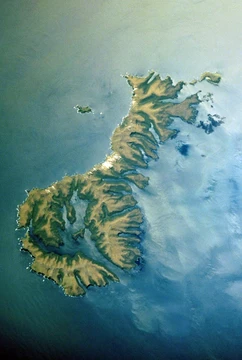
**Distribution** Atlantic yellow-nosed albatrosses breed on mid-Atlantic islands, including Tristan da Cunha (Inaccessible Island, Middle Island, Nightingale Island, Stoltenhoff Island) and Gough Island. At sea, they range across the South Atlantic from South America to Africa, between 15°S and 45°S.
**Behaviour** *Feedi
- Scientific name
- Thalassarche chlororhynchos
- Average length
- 81 cm (32 in)
- IUCN status
- Endangered
- Breeding range
- 80 km² (31 sq mi)
- Population estimate
- 55,000–83,200 total adult birds (1983 estimate, now outdated)
- Primary threat
- Longline fishing
Lore & Background
The Atlantic yellow-nosed albatross was formally described in 1789 by German naturalist Johann Friedrich Gmelin in his revised edition of Carl Linnaeus's Systema Naturae. Gmelin placed it in the genus Diomedea and coined the binomial name Diomedea chlororhynchos, basing his description on the 'yellow-nosed albatross' described and illustrated in 1785 by English ornithologist John Latham from a specimen collected off the Cape of Good Hope. It is now one of nine species in the genus Thalassarche, introduced in 1853 by German naturalist Ludwig Reichenbach.
The species is monotypic, with no recognized subspecies. Its bill is black with a yellow culminicorn and a pink tip. It has a grey head, large eye patch, white nape and hindneck, blackish grey saddle, tail and upperwing, and white underparts with a narrow black margin on the underwing and primaries. Juveniles have a white head and black bill. It can be differentiated from the Indian yellow-nosed albatross by its darker head, and from other mollymawks by its smaller size, narrow wings, and thin black underwing edging.
Reader's Guide
The Atlantic yellow-nosed albatross is a significant species in the mid-Atlantic ecosystem, nesting on islands including Tristan da Cunha (Inaccessible, Middle, Nightingale, Stoltenhoff) and Gough Island. At sea it ranges across the south Atlantic from South America to Africa between 15°S and 45°S. It feeds on squid, fish, cuttlefish and crustacea, sometimes hunting at night.
Breeding occurs in colonies, with nests built in scrubs or on cliffs among Blechnum tree ferns. Pedestal nests of mud, peat, feathers, and vegetation hold one egg laid in September or early October; chicks fledge in late March to April. The species breeds annually.
Listed as endangered by the IUCN, its population was estimated at 27,500–41,600 breeding pairs (55,000–83,200 total adults) in 1983, but this is outdated. Trends suggest a 50% decrease over 72 years. The largest threat is longline fishing, though harvesting of chicks and adults has been outlawed. Conservation efforts include counting birds on Gough Island, remote tracking of the Tristan da Cunha population, and a resolution by the South East Atlantic Fisheries Commission requiring fishing vessels to use tori lines and drop lines at night. Gough Island and Inaccessible Island are nature preserves, and Gough Island is a World Heritage Site.
Did You Know?
- The Atlantic yellow-nosed albatross was once considered the same species as the Indian yellow-nosed albatross, and some authorities still treat them as conspecific.
- Its specific epithet chlororhynchos combines Ancient Greek khlōros meaning 'yellow' and rhunkhos meaning 'bill'.
- It builds pedestal nests of mud, peat, feathers, and vegetation, laying a single egg in September or early October.
- The largest threat to this species is longline fishing; harvesting of chicks and adults has been outlawed.
More in Birds of subantarctic islands 1-24
Spotted an error? Know more?
This is a living reference — every entry is fact-audited, and reader corrections feed straight into our audit queue. Suggest an edit · See this site's audit record