Blue petrel
A small seabird of the Southern Ocean, nesting near the Antarctic Convergence.
The blue petrel (Halobaena caerulea) is a small seabird belonging to the shearwater and petrel family, Procellariidae. It is the sole species in the genus Halobaena and is closely related to the prions. Its range spans the Southern Ocean, but it only breeds on a handful of islands near the Antarctic Convergence.
First described in 1777 by German naturalist Georg Forster during Captain James Cook’s second voyage, the bird was given its scientific name, *Procellaria caerulea*, in 1789 by Johann Friedrich Gmelin. French naturalist Charles Lucien Bonaparte later placed it in its own genus, *Halobaena*, in 1856. The genus name combines the Ancient Greek words for “sea” and “to tread,” while the species name *caerulea* comes from Latin for “blue.” The common name “petrel” references Saint Peter walking on water, alluding to the bird’s habit of appearing to run on the water’s surface when taking off. No subspecies are recognized.
Like all members of the order Procellariiformes, the blue petrel has nasal passages attached to the upper bill (naricorns), a bill divided into seven to nine horny plates, and a salt gland above the nasal passage that excretes a concentrated saline solution to manage salt intake from seawater. It also produces a stomach oil rich in wax esters and triglycerides, stored in the proventriculus, which serves both as a defense against predators and as a high-energy food for chicks and adults on long flights.
The bird’s plumage is mainly blue-grey, with a dark “M” shape stretching across the upper wing from tip to tip. It has a distinct black cap, white cheeks, a white underside with dark patches on the sides of the neck, and a square tail tipped in white. Its bill is slender and black. Adults measure 26–32 cm (10–13 in) in length, with a wingspan of 62–71 cm (24–28 in) and a weight of about 200 g (7.1 oz).
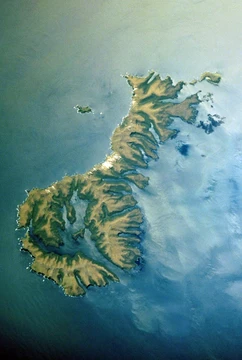
The blue petrel lives in the southern oceans, ranging as far north as South Africa, Australia, and parts of South America. It breeds mostly between 47° and 56° south, on subantarctic islands such as the Diego Ramírez Islands, Crozet Islands, Kerguelen Islands, Macquarie Island, South Georgia, and Prince Edward Island. In 2014, a breeding colony was discovered on Gough Island, over 700 km north of its usual range. Breeding there occurs later than at southern colonies, so this may not be a recent range expansion.
Its diet consists mainly of
- Scientific name
- Halobaena caerulea
- Family
- Procellariidae
- Length
- 26–32 cm (10–13 in)
- Wingspan
- 62–71 cm (24–28 in)
- Weight
- Approximately 200 g (7.1 oz)
- Population
- 3,000,000 adult birds
- Conservation status
- Least Concern
Lore & Background
The blue petrel was first described in 1777 by German naturalist Georg Forster in his book A Voyage Round the World, after he accompanied James Cook on Cook's second voyage to the Pacific. Forster did not give it a binomial name; that was provided in 1789 by Johann Friedrich Gmelin, who coined Procellaria caerulea. The species is now placed in the genus Halobaena, introduced in 1856 by French naturalist Charles Lucien Bonaparte. The name Halobaena combines Ancient Greek hals, halos meaning 'sea' with bainō meaning 'to tread'; the specific epithet caerulea is Latin for 'blue'.
The blue petrel's plumage is predominantly blue-grey with a dark 'M' across the upperwing, a black cap, white cheeks, and a white-tipped square tail. It feeds mainly on krill, other crustaceans, small fish, squid, and occasionally insects, diving to depths of up to 6.2 m (20 ft). It breeds colonially in burrows, laying one egg per attempt; both parents incubate for about 50 days, and the chick fledges after 55 days. Skuas are the main danger to eggs and chicks.
Reader's Guide
The blue petrel is significant as the sole member of the genus Halobaena, illustrating a distinct evolutionary lineage within the Procellariidae. Its breeding range is tightly linked to the Antarctic Polar Front, with most colonies between 47° and 56° S. A notable 2014 discovery of a breeding colony on Gough Island, more than 700 km north of its usual range, suggests either a recent expansion or a previously overlooked population; breeding there occurs later, so it does not necessarily indicate a range shift. The species is rated Least Concern by the IUCN, with an estimated 3 million adults, reflecting a stable population across a very large range. Its ability to produce stomach oil for defense and chick feeding, and to excrete salt via nasal glands, are adaptations shared with other Procellariiformes. The blue petrel's reliance on krill ties it to Southern Ocean food webs, making it a potential indicator of ecosystem changes near the Antarctic Convergence.
Did You Know?
- The blue petrel is the only species in the genus Halobaena.
- It can dive to a depth of up to 6.2 m (20 ft) while feeding.
- A breeding colony was discovered on Gough Island in 2014, over 700 km north of its known range.
- Both parents incubate the single egg for approximately 50 days.
More in Birds of subantarctic islands 1-24
Spotted an error? Know more?
This is a living reference — every entry is fact-audited, and reader corrections feed straight into our audit queue. Suggest an edit · See this site's audit record