Chinstrap penguin
A black-banded, aggressive penguin of the Southern Ocean.
The chinstrap penguin (*Pygoscelis antarcticus*) lives on islands and coastlines in the Southern Pacific and Antarctic Oceans. It gets its name from the thin black band beneath its head, which looks like a black helmet. It is also called the ringed, bearded, or stonecracker penguin and is noted for its loud, harsh call. This species is widely regarded as the most aggressive and ill-tempered of all penguins.
First described in 1781 by Johann Reinhold Forster as *Aptenodytes antarctica*, it was grouped with king and emperor penguins. In 1990, Graham Turbott moved it to the genus *Pygoscelis*, alongside Adélie and gentoo penguins, giving it the name *P. antarctica*. That name contains a grammatical error, so the correct form is *P. antarcticus*.
Adults measure 68–76 cm (27–30 in) in length and weigh 3.2–5.3 kg (7.1–11.7 lb), with males larger than females. Their flippers are black with white edges and white inner sides. The face, chin, and throat are white, extending behind the reddish-brown eyes. The short bill is black, and the strong legs and webbed feet are pink. Their short legs cause a distinct waddle. The black back and white belly provide countershading camouflage against predators.
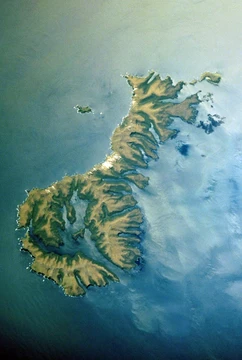
Chinstrap penguins have a circumpolar distribution, breeding in Antarctica, Argentina, Bouvet Island, Chile, the French Southern Territories, and South Georgia and the South Sandwich Islands. Vagrants have been spotted in New Zealand, Saint Helena, Tristan da Cunha, and South Africa.
Their diet includes small fish, krill, shrimp, and squid, and they swim up to 80 km (50 mi) offshore daily to feed. Dense feathers provide waterproofing, while thick blubber and intricate blood vessels in the flippers and legs conserve heat. At sea, the main predator is the leopard seal, which reduces the population by 5–20% each year. On land, brown skuas, south polar skuas, and southern giant petrels prey on eggs and chicks. Antarctic fur seals occasionally kill adults.
On land, they build circular stone nests and lay two eggs. Both parents take turns incubating for about six-day shifts. Chicks hatch after roughly 37 days, with fluffy grey backs and white fronts. They stay in the nest for 20–30 days, then join a crèche. At around 50–60 days old, they molt into adult feathers and head to sea. Chinstrap penguins are known for attacking anything that approaches their nesting grounds that is
- Scientific name
- Pygoscelis antarcticus
- Length
- 68–76 cm (27–30 in)
- Weight
- 3.2–5.3 kg (7.1–11.7 lb)
- IUCN status
- Least concern (as of 2016)
- Estimated population
- Around 8 million individuals (2018)
- Primary predator
- Leopard seal (Hydrurga leptonyx)
Lore & Background
The chinstrap penguin was initially given the scientific name Aptenodytes antarctica by Johann Reinhold Forster in 1781, placing it in the same genus as king and emperor penguins. In 1990, Graham Turbott transferred it into the genus Pygoscelis, together with the Adélie and gentoo penguins, giving it the name P. antarctica. However, this is an orthographic error due to disagreement in Latin grammar, and the corrected form P. antarcticus is the currently accepted name.
Chinstrap penguins breed in Antarctica, Argentina, Bouvet Island, Chile, the French Southern Territories, and South Georgia and the South Sandwich Islands. They build circular nests from stones and lay two eggs, which are incubated by both parents in shifts of around 6 days. The chicks hatch after about 37 days and join a crèche after 20–30 days, then molt and go to sea at around 50–60 days old.
In 2004, two male chinstrap penguins named Roy and Silo at the Central Park Zoo in New York City formed a pair bond and took turns trying to hatch a rock. A keeper substituted a fertile egg, and the pair subsequently hatched and raised the chick. This event inspired the children's book And Tango Makes Three.
Reader's Guide
The chinstrap penguin is significant as a widely distributed Antarctic species with a circumpolar breeding range. Its population is estimated at around 8 million individuals, though it is believed to be decreasing overall. The species is classified as least concern on the IUCN Red List due to its large range and population, but it faces threats from climate change, which reduces krill abundance and likely makes reproduction less successful. A 2019 expedition to breeding grounds on Elephant Island found a 50% population decline in just under 50 years. Other potential threats include volcanic events and human fishing for krill. The chinstrap penguin's aggressive behavior and distinctive appearance make it a notable subject of study in penguin behavior and ecology. Its ability to microsleep over 10,000 times a day in 4-second bouts, including both bihemispheric and unihemispheric slow-wave sleep, highlights unique adaptations to its environment. The species also serves as a cultural touchstone through the story of Roy and Silo, which brought attention to same-sex pair bonding in animals.
Did You Know?
- Chinstrap penguins microsleep over 10,000 times a day in 4-second bouts.
- The species was originally named Aptenodytes antarctica by Johann Reinhold Forster in 1781.
- Two male chinstrap penguins named Roy and Silo hatched and raised a chick at the Central Park Zoo in 2004.
- Their black back and white underside provide countershading camouflage against predators.
More in Birds of subantarctic islands 1-24
Spotted an error? Know more?
This is a living reference — every entry is fact-audited, and reader corrections feed straight into our audit queue. Suggest an edit · See this site's audit record