Black-faced sheathbill
A terrestrial scavenger of subantarctic islands.
The black-faced sheathbill (Chionis minor), also known as the lesser sheathbill or paddy bird, is one of just two sheathbill species—unusual shorebirds that live on land and scavenge across subantarctic islands. This bird has a stout, short-necked, pigeon-like build, with white feathers, a black bill, and black facial skin and caruncles. It ranges from 38 to 41 cm long, has a wingspan of 74 to 79 cm, and weighs between 460 and 730 g, with males slightly larger than females.
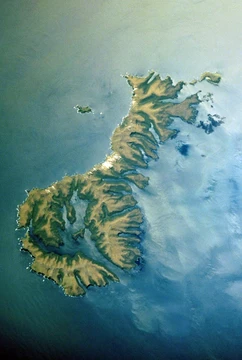
Its distribution is limited to subantarctic islands in the southern Indian Ocean: the Prince Edward Islands (South African territory), the Crozet and Kerguelen Islands (French territories), and Heard Island (Australian territory). The subspecies C. m. nasicornis is found only on Heard Island, while C. m. marionesis is unique to the Prince Edward Islands.
These birds inhabit coastlines and intertidal zones, especially near seabird and seal colonies, and also around human settlements. They are opportunistic omnivores, predators, and scavengers, eating strandline debris, algae, other plants, invertebrates, fish, seabird eggs and chicks, seal milk, blood, placentas, carrion, feces, rodents, and human garbage.
Their calls are loud, high-pitched, strident, and staccato. They nest in crevices, caves, and under boulders, building untidy piles of vegetation and debris from seabird and seal colonies. A typical clutch contains two or three creamy-white eggs with brown blotches or speckles. The incubation period is about 30 days. Young are semi-precocial and stay in the nest; they fledge roughly 50 days after hatching and begin breeding at three to five years old.
The species is at risk from scavenging toxic waste and from introduced predators like feral cats. However, its large, scattered range and lack of evidence for a major population decline mean its conservation status is assessed as Least Concern.
- length
- 38–41 cm
- wingspan
- 74–79 cm
- weight
- 460–730 g
- conservation_status
- Least Concern
- clutch_size
- 2–3 eggs
- incubation_period
- c.30 days
- fledging_period
- c.50 days
Lore & Background
The black-faced sheathbill is restricted to subantarctic islands in the southern Indian Ocean, including the Prince Edward Islands, Crozet Islands, Kerguelen Islands, and Heard Island. Two races exist: C. m. nasicornis is endemic to Heard Island, and C. m. marionesis is endemic to the Prince Edward Islands. Its habitat includes coastlines and intertidal zones, especially around seabird and seal colonies and near human habitation.
Reader's Guide
As an opportunistic omnivore, the black-faced sheathbill feeds on strandline debris, algae, vegetation, invertebrates, fish, seabird eggs and chicks, seal milk, blood, placentas, carrion, faeces, rodents, and human refuse. It nests in crevices, caves, and under boulders on piles of vegetation and debris, laying 2–3 creamy-white eggs blotched with brown. The species is at risk from scavenging toxic wastes and introduced predators like feral cats, but its large, scattered range and lack of significant population decline result in a conservation status of Least Concern.
Did You Know?
- The black-faced sheathbill is one of only two species of sheathbills.
- It measures 38–41 cm in length and weighs 460–730 g.
- Its diet includes seal milk, blood, placentas, and human refuse.
- The race C. m. nasicornis is endemic to Heard Island.
More in Birds of subantarctic islands 1-24
Spotted an error? Know more?
This is a living reference — every entry is fact-audited, and reader corrections feed straight into our audit queue. Suggest an edit · See this site's audit record