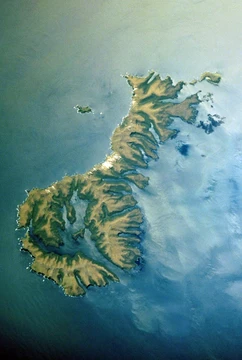
Gentoo penguin
A penguin species with a white bonnet and trumpeting call.
The gentoo penguin (Pygoscelis papua) is a penguin species in the genus Pygoscelis, most closely related to the Adélie and chinstrap penguins. It is known for its distinctive white bonnet-like stripe across the head, bright orange-red bill, and loud trumpeting call. The species was first scientifically described in 1781 by Johann Reinhold Forster, with a type locality in the Falkland Islands, though its specific name 'papua' is a misnomer based on an erroneous assumption that it occurred in Papua New Guinea.
- Scientific name
- Pygoscelis papua
- First described
- 1781 by Johann Reinhold Forster
- Type locality
- Falkland Islands
- Maximum length
- 70–90 cm (28–35 in)
- Maximum weight (male)
- 8.5 kg (19 lb)
- Maximum weight (female)
- 8.2 kg (18 lb)
- Fastest underwater swim speed
- 36 km/h (22 mph)
Lore & Background
The gentoo penguin is one of three species in the genus Pygoscelis. Mitochondrial and nuclear DNA evidence suggests the genus split from other penguins around 38 million years ago. The Adélie penguins split from the other members of the genus around 19 million years ago, and the chinstrap and gentoo penguins diverged around 14 million years ago. There are four subspecies recognized by the International Ornithological Congress, though a 2020 study proposed splitting the gentoo into a species complex of four separate species, a result partially incorporated in 2021 by relegating them to subspecies.
The origin of the name 'gentoo' is unclear. It may derive from the Portuguese 'gentio' (pagan, gentile) or be a variation of 'Johnny penguin'. The specific name 'papua' is a misnomer; Forster mistakenly assumed the species occurred in Papua New Guinea, though the closest gentoos are over 6,000 km to the south on Macquarie Island. No penguins are found in New Guinea. The error may trace to a 'possibly fraudulent claim' in 1776 by French naturalist Pierre Sonnerat.
Gentoo penguins breed on many subantarctic islands, with main colonies on the Falkland Islands, South Georgia and the South Sandwich Islands, and Kerguelen Islands. They build nests from stones, which are jealously guarded. Two eggs are laid, and parents share incubation. Chicks form crèches after about 30 days and go to sea at 80–100 days. Their diet consists mainly of fish, crustaceans, and cephalopods, varying by season.
Reader's Guide
The gentoo penguin is significant as the third-largest penguin species and the fastest underwater swimmer among all penguins, reaching speeds up to 36 km/h. Its physiology includes a highly developed salt gland above the eyes to excrete excess sodium from its high-salt diet. The species is well adapted to frigid climates and is rapidly increasing in the maritime Antarctic due to regional climate change, colonizing previously inaccessible southern territories.
Taxonomically, the gentoo penguin is a subject of ongoing debate, with evidence suggesting it may be a species complex rather than a single species. The 2020 study proposing four separate species—northern, southern, eastern, and South Georgia gentoo—was partially adopted by the International Ornithological Congress in 2021, which relegated them to subspecies. A 2026 study based on genome sequencing of ten colonies further proposes recognizing four species within Pygoscelis papua.
As of 2019, the IUCN Red List lists the gentoo as least concerned with a stable population trend, though rapid declines in some key areas are believed to be driving a mode. Its predators include leopard seals, sea lions, killer whales, skuas, giant petrels, kelp gulls, and snowy sheathbills. The species' conservation status reflects both its adaptability and the challenges posed by environmental changes.
Did You Know?
- The gentoo penguin is the fastest underwater swimmer of all penguins, reaching speeds up to 36 km/h (22 mph).
- The specific name 'papua' is a misnomer; no penguins are found in New Guinea, and the closest gentoos are over 6,000 km to the south.
- Gentoo penguins have a highly developed salt gland above their eyes that produces a highly saline solution dripped from the tip of the beak.
- A 2026 study based on genome sequencing of ten colonies proposes recognizing four species within Pygoscelis papua.
More in Birds of subantarctic islands 1-24
Spotted an error? Know more?
This is a living reference — every entry is fact-audited, and reader corrections feed straight into our audit queue. Suggest an edit · See this site's audit record