Great shearwater
Large shearwater with a reverse migration from south to north.
The great shearwater (Ardenna gravis) is a large seabird in the family Procellariidae. It breeds colonially on rocky islands in the South Atlantic and ranges widely in the Atlantic outside the breeding season. Notable for its circular migration from the Southern Hemisphere to the Northern Hemisphere, it is one of only a few bird species to follow this reverse pattern.
- Scientific name
- Ardenna gravis
- Length
- 43–51 cm (16.9–20.1 in)
- Wingspan
- 105–122 cm (3.5–4.0 ft)
- Breeding grounds
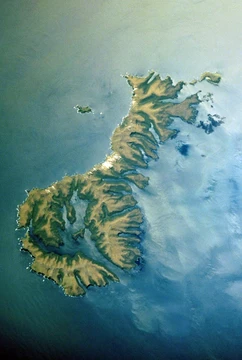
- Nightingale Island, Inaccessible Island, Tristan da Cunha, Gough Island
- Diet
- Fish, squid, crustaceans, fish entrails, refuse
- Conservation status
- Not specified in source
Lore & Background
The great shearwater was formally described in 1818 by Irish naturalist Bernard O'Reilly under the binomial name Procellaria gravis. It is now placed in the genus Ardenna, introduced in 1853 by Ludwig Reichenbach. The genus name Ardenna was used by Italian naturalist Ulisse Aldrovandi in 1603 to refer to a seabird, and the specific epithet gravis is Latin for 'heavy' or 'weighty'. The species is monotypic, with no recognised subspecies.
Reader's Guide
The great shearwater is significant for its distinctive migration pattern, breeding in the South Atlantic and moving north along the eastern seaboard of South and then North America before crossing the Atlantic in August. It can be common off southwestern coasts of Great Britain and Ireland before returning south down the eastern Atlantic. Its stiff, shearing flight and white 'horseshoe' on the tail base aid identification. The species is gregarious, often seen in large numbers from ships, and readily follows fishing boats for refuse. It has a piercing 'eeyah' cry and is among seabird species with the highest incidence of plastic ingestion. Its breeding colonies on remote islands are visited only at night to avoid gull predation.
Did You Know?
- The great shearwater is one of only a few bird species to migrate from breeding grounds in the Southern Hemisphere to the Northern Hemisphere.
- It lays a single white egg in a small burrow or in open grass, visiting nests only at night to avoid predation by large gulls.
- The species has a piercing 'eeyah' cry usually given when resting in groups on the water.
- Great shearwaters are among the seabird species with the highest incidence of plastic ingestion.
More in Birds of subantarctic islands 1-24
Spotted an error? Know more?
This is a living reference — every entry is fact-audited, and reader corrections feed straight into our audit queue. Suggest an edit · See this site's audit record