Grey-backed storm petrel
Small seabird with a pale back and white belly.
The grey-backed storm petrel (Garrodia nereis) is a seabird belonging to the austral storm petrel family Oceanitidae, and it is the only species in its genus, Garrodia. Its range includes Antarctica, Argentina, Australia, Chile, the Falkland Islands, the French Southern Territories, New Zealand, Saint Helena, South Africa, and South Georgia and the South Sandwich Islands. This bird lives in open seas and is strongly drawn to bright lights, particularly when visibility is poor.
The genus name Garrodia was introduced by William Alexander Forbes in 1881, honoring English zoologist Alfred Henry Garrod, while the species name nereis refers to the Nereids, sea nymphs from Greek mythology.
A small bird, the grey-backed storm petrel weighs between 21 and 44 grams and has a wingspan of 39 to 40 centimeters. It is mostly dark grey, with a black head and belly. Unlike other storm petrels in its region, which have white rumps, this species has a light grey rump. It also features a pale back, black legs, a square tail, and a white belly.
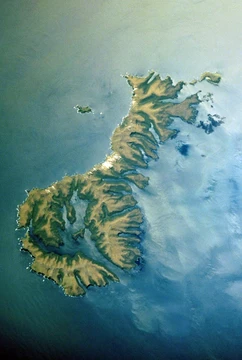
The species is found in three separate subantarctic populations: one near South America, one near South Africa, and one near Australia. It breeds on the Falkland Islands, Chatham Islands, Gough Island, Crozet Islands, Kerguelen Island, the New Zealand Subantarctic Islands, and in Fiordland on New Zealand’s mainland. The first known fossil of Garrodia nereis was discovered in the Te Waka #1 rock shelter, located 900 meters above sea level in inland Hawke’s Bay, North Island, New Zealand.
Outside the breeding season, grey-backed storm petrels are mostly solitary. They breed in large colonies from August to March, with both parents sharing the duties of raising their young.
- Scientific name
- Garrodia nereis
- Family
- Oceanitidae
- Genus
- Garrodia (monotypic)
- Weight
- 21–44 g
- Wingspan
- 39–40 cm
- Breeding range
- Falkland Islands, Chatham Islands, Gough Island, Crozet Islands, Kerguelen Island, New Zealand Subantarctic Islands, Fiordland
- First fossil record
- Te Waka #1, Hawke's Bay, North Island, New Zealand
Lore & Background
The genus Garrodia was created by William Alexander Forbes in 1881 and named after English zoologist Alfred Henry Garrod, while the specific descriptor is an allusion to the Nereids, the sea nymphs of Greek mythology. The grey-backed storm petrel is a small bird, 21–44 g in weight with a 39–40 cm wingspan. Like others in its family it is dark grey overall with a black head and belly, but it can be distinguished from other storm-petrels in its range by its light grey rump compared to the white rump on others. The grey-backed petrel has a pale back, black legs, a square tail and a white belly.
Reader's Guide
The grey-backed storm petrel is significant as the sole member of the genus Garrodia, highlighting its distinct evolutionary lineage within the austral storm petrels. Its distribution across three disjunct subantarctic populations—off South America, South Africa, and Australia—illustrates a fragmented breeding range that includes remote islands such as the Falklands, Chatham Islands, Gough Island, Crozet Islands, Kerguelen Island, and the New Zealand Subantarctic Islands, as well as Fiordland on the New Zealand mainland. The species' behavior includes solitary habits outside the breeding season and colonial breeding from August to March with shared parental duties. Its strong attraction to bright lights in low visibility conditions is a notable behavioral trait. The first fossil record of Garrodia nereis was discovered in a rock shelter called Te Waka #1, 900 m above sea level in inland Hawke's Bay, North Island, New Zealand, providing evidence of its historical presence in that region.
Did You Know?
- The genus Garrodia was created by William Alexander Forbes in 1881 and named after English zoologist Alfred Henry Garrod.
- The specific name nereis alludes to the Nereids, the sea nymphs of Greek mythology.
- It can be distinguished from other storm-petrels by its light grey rump instead of a white rump.
- The first fossil record of this species was found in a rock shelter called Te Waka #1, 900 m above sea level in inland Hawke's Bay, North Island, New Zealand.
More in Birds of subantarctic islands 1-24
Spotted an error? Know more?
This is a living reference — every entry is fact-audited, and reader corrections feed straight into our audit queue. Suggest an edit · See this site's audit record