Grey-headed albatross
A circumpolar albatross with a golden bill and ashy-gray head.
The grey-headed albatross (Thalassarche chrysostoma), sometimes called the gray-headed mollymawk, is a big seabird in the albatross family. It lives and breeds on remote islands all around the Southern Ocean, and it feeds farther south than any other mollymawk. Its common name comes from its ashy-grey head, throat, and upper neck.
Mollymawks are a kind of albatross in the family Diomedeidae, which belongs to the order Procellariiformes—a group that also includes shearwaters, fulmars, storm petrels, and diving petrels. These birds share several traits. They have nasal passages (called naricorns) attached to the upper bill, though albatross nostrils sit on the sides of the bill. Their bills are split into seven to nine horny plates. They also produce a stomach oil made of wax esters and triglycerides, stored in the proventriculus, which they use to defend against predators and as a high-energy food for chicks and for adults on long flights. A salt gland above the nasal passage helps them get rid of excess salt from seawater, excreting a concentrated brine through the nostrils.
The scientific name *chrysostoma* comes from Greek: *khrusos* means "gold" and *stoma* means "mouth," referring to the bird's golden bill.
An adult grey-headed albatross averages about 81 cm (32 in) in length and has a wingspan of 2.2 m (7.2 ft). Its weight ranges from 2.8 to 4.4 kg (6.2 to 9.7 lb), with an average of 3.65 kg (8.0 lb). The head, throat, and upper neck are dark ashy-grey, while the upper wings, mantle, and tail are nearly black. The rump and underparts are white, and there is a white crescent behind each eye. The bill is black with bright yellow upper and lower ridges that fade to pink-orange at the tip. Underwings are white with a broad black leading edge and a narrower black trailing edge. Juveniles have a black bill and head, a darker nape, a less distinct eye crescent, and underwings that are almost entirely dark.
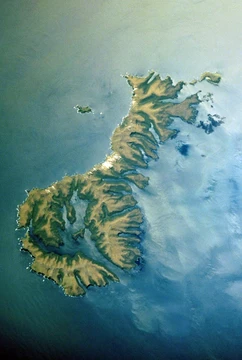
These albatrosses nest in colonies on several Southern Ocean islands. Large colonies exist on South Georgia in the South Atlantic, with smaller ones on Islas Diego Ramírez, the Kerguelen Islands, the Crozet Islands, Marion Island, and the Prince Edward Islands in the Indian Ocean, as well as Campbell Island and Macquarie Island south of New Zealand, and Chile. During breeding, they forage within or south of the Antarctic Polar Frontal Zone. Birds roostin
- average_length
- 81 cm (32 in)
- wingspan
- 2.2 m (7.2 ft)
- mean_mass
- 3.65 kg (8.0 lb)
- incubation_period
- 72 days
- fledging_period
- 141 days
- conservation_status
- Endangered (IUCN)
- estimated_population_2004
- 250,000
Lore & Background
The grey-headed albatross nests in colonies on several islands in the Southern Ocean, including large colonies on South Georgia and smaller ones on Islas Diego Ramírez, Kerguelen Islands, Crozet Islands, Marion Island, Prince Edward Islands, Campbell Island, Macquarie Island, and Chile. While breeding, it forages within or south of the Antarctic Polar Frontal Zone, and birds roosting near Marion Island forage in the sub-tropical zone. Juveniles and non-breeding adults fly freely throughout all southern oceans, north to 35°S.
At sea, the species is highly pelagic, feeding predominantly on squid, along with fish, crustacea, carrion, cephalopods, and lampreys. Krill is less important. It can dive as deep as 7 m (23 ft) but does so infrequently. A single egg is laid in a large nest on steep slopes or cliffs with tussock grass, incubated for 72 days. Chicks are fed about 616 g of food every 1.2 days, reaching around 4,900 g before losing weight prior to fledging at 141 days. Chicks generally do not return to the colony for 6–7 years and breed later. Successful pairs take the following year off. Non-breeding adults may travel enormous distances, with tracked birds showing three strategies: remaining in the breeding home range, migrating to the south-west Indian Ocean, or making one or more complete circumnavigations of the globe; the fastest recorded circumnavigation took 46 days.
Reader's Guide
The grey-headed albatross is significant as a large seabird with a circumpolar distribution in the Southern Ocean, nesting on isolated islands and feeding at higher latitudes than other mollymawks. Its conservation status is endangered, with rapidly declining numbers at South Georgia, which holds about half the world's population. The overall population trend shows a 30–40% reduction over 90 years (three generations). Major threats include illegal or unregulated longline fishing for Patagonian toothfish in the Indian Ocean, which caused 10,000–20,000 deaths of this species in 1997 and 1998. Conservation efforts include studies at most nesting islands; Prince Edward Islands is a special nature preserve, and Campbell Island and Macquarie Island are World Heritage Sites. The species' ability to circumnavigate the globe in as little as 46 days highlights its remarkable pelagic range and endurance.
Did You Know?
- The name chrysostoma comes from Greek words meaning 'gold' and 'mouth', referring to its golden bill.
- Grey-headed albatrosses can dive as deep as 7 m (23 ft) to chase prey, but do not do so frequently.
- The fastest recorded circumnavigation of the globe by a non-breeding grey-headed albatross took 46 days.
- Illegal fishing for Patagonian toothfish in the Indian Ocean killed 10,000–20,000 grey-headed albatrosses in 1997 and 1998.
More in Birds of subantarctic islands 1-24
Spotted an error? Know more?
This is a living reference — every entry is fact-audited, and reader corrections feed straight into our audit queue. Suggest an edit · See this site's audit record