Grey petrel
A pelagic seabird of the Southern Hemisphere, threatened by fishing and predators.
The grey petrel (Procellaria cinerea) is a seabird from the Procellariidae family, also known as the brown petrel, pediunker, or grey shearwater. It lives in the open ocean of the Southern Hemisphere, typically between 32°S and 58°S.
The species was first formally described in 1789 by German naturalist Johann Friedrich Gmelin, who based his work on the "cinereous fulmar" described by English ornithologist John Latham in 1785. Its genus name, *Procellaria*, comes from the Latin for "storm" or "gale," while *cinerea* means "ash-grey" in Latin. The common name "petrel" refers to Saint Peter walking on water, as these birds appear to run on the water's surface when taking off. Other names include black-tailed shearwater, bulky petrel, and great grey petrel.
This large bird averages 50 cm (20 in) in length, with a wingspan of 115–130 cm (45–51 in) and a weight of about 1,000 g (35 oz). It has a brownish-grey mantle, back, and upperwings, a white belly, and ash-grey underwings and undertail. Its bill is yellow-green, and its feet are pink-grey. Like all Procellariiformes, it has nasal passages called naricorns on its upper bill, and its bill is divided into seven to nine horny plates. It produces a stomach oil made of wax esters and triglycerides, stored in the proventriculus, which can be sprayed as a defense or used as food for chicks and adults on long flights. A salt gland above the nasal passage helps desalinate its body by excreting a high-salinity solution from the nose.
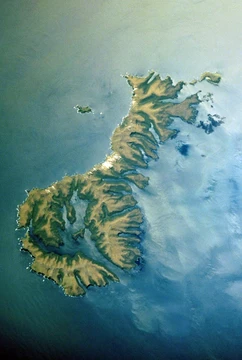
During the non-breeding season, grey petrels stay between 32°S and 58°S. They breed in colonies on several islands, with the largest populations on Antipodes Island (about 53,000 pairs) and Gough Island (10,000 pairs). Other breeding sites include the Prince Edward Islands, Marion Island, Tristan da Cunha, Crozet Islands, Kerguelen Islands, Amsterdam Island, Campbell Island, and Macquarie Island. Their total range covers 68,800,000 km² (26,563,829 sq mi).
Grey petrels return to breeding grounds in February and March, building burrows on well-drained, steep terrain, often among *Poa* tussock grass. They lay a single egg by late March or early April, and both parents incubate it. After hatching, both care for the chick until it fledges between late September and early December. They feed mainly on cephalopods, diving from heights of up to 10 m (33 ft), and often follow pods of cetaceans.
- Scientific name
- Procellaria cinerea
- Family
- Procellariidae
- Order
- Procellariiformes
- Average length
- 50 cm (20 in)
- Wingspan
- 115–130 cm (45–51 in)
- Weight
- Around 1,000 g (35 oz)
- Occurrence range
- 68,800,000 km²
Lore & Background
The grey petrel was formally described in 1789 by the German naturalist Johann Friedrich Gmelin under the binomial name Procellaria cinerea, based on the 'cinereous fulmar' described by English ornithologist John Latham in 1785. Its genus name comes from the Latin procella meaning 'storm' or 'gale', and its specific name cinerea from the Latin cinereus meaning 'ash-grey' or 'ash-coloured'. The word petrel is derived from Saint Peter and the story of his walking on water, referencing the birds' habit of appearing to run on the water to take off.
As a member of the Procellariiformes, the grey petrel shares identifying features: nasal passages called naricorns attached to the upper bill, a bill split into between seven and nine horny plates, production of stomach oil made of wax esters and triglycerides stored in the proventriculus (used for defense and as an energy-rich food source), and a salt gland above the nasal passage that excretes a high-salinity solution to desalinate their bodies.
Grey petrels are pelagic and typically stay between 32°S and 58°S during the non-breeding season. During breeding season, they form colonies on several islands, with the largest colonies on Antipodes Island (estimated 53,000 pairs) and Gough Island (10,000 pairs). They return to breeding grounds in February and March, building burrows on well-drained ground, often among Poa tussock grass on steep terrain. They lay one egg by late March or early April, with both parents incubating and caring for the chick until it fledges between late September and early December.
Reader's Guide
The grey petrel is a significant species in the Southern Hemisphere's pelagic ecosystem, primarily feeding on cephalopods and often following pods of cetaceans. Its population is believed to be shrinking slowly or possibly rapidly, with introduced predators such as cats, brown rats, black rats, weka, and house mice contributing to the decline, along with longline fishing. The bird is the most commonly caught bycatch by longline fisheries in New Zealand waters, with an estimate of 45,000 birds taken in the last 20 years.
Conservation efforts include its placement on CMS Appendix II and ACAP Annex1. Gough Island has been designated a World Heritage Site. Antipodes Island began long-term monitoring in 2007. In 2001, brown rats were eradicated from Campbell Island, and in 2006, SEAFO tightened longline fishing regulations. Planned conservation measures include a census on all breeding locations, studies on Gough Island pertaining to house mice, and stricter fishing regulations enforced by FAO, RFMO, and ACAP. The species' occurrence range is 68,800,000 km², highlighting its wide distribution and the need for international cooperation in its conservation.
Did You Know?
- The grey petrel is the most commonly caught bycatch by longline fisheries in New Zealand waters, with an estimated 45,000 birds taken in the last 20 years.
- It produces a stomach oil made of wax esters and triglycerides that can be sprayed as a defense against predators.
- The largest breeding colony is on Antipodes Island, with an estimated 53,000 pairs.
- Its bill is split into between seven and nine horny plates, a feature unique to the order Procellariiformes.
More in Birds of subantarctic islands 1-24
Spotted an error? Know more?
This is a living reference — every entry is fact-audited, and reader corrections feed straight into our audit queue. Suggest an edit · See this site's audit record