Indian yellow-nosed albatross
Smallest mollymawk, endangered by longline fisheries and disease.
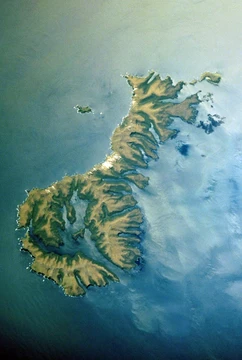
The Indian yellow-nosed albatross (Thalassarche carteri) is a member of the albatross family and the smallest of the mollymawks. It breeds on islands in the Indian Ocean, including Prince Edward Islands, the Crozet Islands, Kerguelen Island, Amsterdam Island, and St Paul Islands. The species was split from the Atlantic yellow-nosed albatross by BirdLife International in 2004, though Clements and the SACC have not yet adopted the split, with the SACC recognizing the need for a proposal.
- weight
- 2.55 kg (5.6 lb)
- length
- 76 cm (30 in)
- wingspan
- 2 m (6.6 ft)
- conservation_status
- Endangered (IUCN)
- breeding_population_estimate
- 41,580 pairs (83,000 mature individuals) as of 2004
- breeding_range
- 1,400 km² (540 sq mi)
- occurrence_range
- 35,300,000 km² (13,600,000 sq mi)
Lore & Background
The Indian yellow-nosed albatross is a colonial breeder, building mud nests in bare rocky areas or among tussock grass or ferns. The nesting season begins in August, with laying around September or October. Incubation lasts about 70 days, and chicks take approximately 115 days to fledge. Adults begin breeding at eight years of age. The species feeds on fish, crustaceans, and cephalopods, and during incubation birds may forage up to 1,500 km from the colony.
Reader's Guide
The Indian yellow-nosed albatross is significant as the smallest mollymawk and as a species whose taxonomy remains disputed, with BirdLife International having split it from the Atlantic yellow-nosed albatross in 2004, while Clements and the SACC have not yet done so. Its conservation status is Endangered, with dramatic declines over the last seventy years attributed to interactions with longline fisheries and outbreaks of introduced diseases such as avian cholera and Erysipelothrix rhusiopathiae. Conservation efforts include monitoring and foraging studies on Amsterdam Island, the protection of Prince Edward Islands as a nature preserve, and a vaccination that has been developed but remains untested. In 2006, the Indian Ocean Tuna Commission adopted a measure requiring longline boats to use bird streamers south of 30°S, and South Africa requires its boats to use a variety of mitigation processes. The species has an occurrence range of 35,300,000 km² and a breeding range of 1,400 km², with a 2004 estimate of about 65,000 adult birds alive.
Did You Know?
- The Indian yellow-nosed albatross is the smallest of the mollymawks.
- Its type-specimen is a black-beaked juvenile, which caused confusion over its status until recently.
- It breeds on Prince Edward Islands, Crozet Islands, Kerguelen Island, Amsterdam Island, and St Paul Islands.
- A vaccination against disease has been developed but remains untested.
More in Birds of subantarctic islands 1-24
Spotted an error? Know more?
This is a living reference — every entry is fact-audited, and reader corrections feed straight into our audit queue. Suggest an edit · See this site's audit record