Kerguelen shag
Smallest blue-eyed shag, endemic to the remote Kerguelen Islands.
The Kerguelen shag (Leucocarbo verrucosus) is a cormorant found only on the Kerguelen Islands, a remote archipelago in the southern Indian Ocean. It is often classified as a subspecies of the imperial shag. This is the smallest of the blue-eyed shags, measuring 65 cm long with a wingspan of 110 cm.
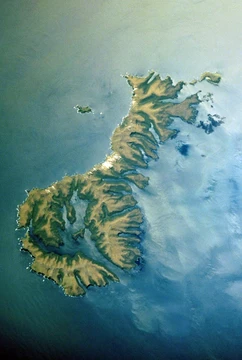
It nests along the coast of Grande Terre, the main island, as well as on nearby offshore islands and those within the Golfe du Morbihan. Foraging happens at sea around the archipelago, usually within 6 km of shore, especially in bays and inlets, though young birds have been spotted up to 80 km out. Reports from Heard Island and western Australia likely involve birds that hitched rides on ships. During the austral summer, it feeds among kelp, sometimes diving to the bottom.
Adults have metallic greenish-black upperparts, tail, and thighs, with a white underbody and brown wing linings. Some individuals show white patches on the back and wings. The head and back of the neck are deep blue or purple, except for a black cap that extends below the eye to the chin and ear coverts. The face and throat pouch are dark brown, decorated with yellow-orange tubercles. The bill is horn-colored or brown, eyes are hazel, and legs and feet range from dark brown to bright pink with dark blotches. Breeding adults grow a small black erectile crest on the forehead, yellow or orange caruncles above the bill base, and a bright blue ring around the eye. After breeding, the plumage fades, the eye-ring turns lead-blue, and the caruncles shrink and dull. Juveniles are dark brown with variable white underneath, a brown iris, bill, and feet, no caruncles, and lead-blue eye-rings. They gradually acquire adult plumage. Unlike many cormorants, this species does not spread its wings when perched.
The diet likely consists mostly of fish and invertebrates like echinoderms, crustaceans, and polychaete worms. In summer, they usually forage alone, but from May to October they form linear flocks of several hundred, diving and surfacing in sequence.
Breeding occurs in colonies, typically of 3 to 30 pairs, though sometimes up to 400. Colonies may be near those of southern rockhopper penguins. Nest-building and displaying happen in late March and early April, an unusual time for a subantarctic cormorant. Males advertise by throwing their heads back until the nape touches the tail. Nests are cones of sea
- Scientific name
- Leucocarbo verrucosus
- Length
- 65 cm
- Wingspan
- 110 cm
- Population (1984–1987)
- 6,000–7,000 pairs
- Clutch size
- 2–4 eggs
- Incubation period
- 29 days
- Endemic to
- Kerguelen Islands
Lore & Background
The Kerguelen shag nests on the coast of Grande Terre, on offshore islands, and on islands in the Golfe du Morbihan. It forages at sea within 6 km of shore, especially in bays and inlets, though immatures have been seen up to 80 km away. Reports from Heard Island and western Australia may be of ship-assisted birds. In the austral summer it feeds among kelp, sometimes at the bottom. Unlike many cormorants, it does not spread its wings when perched.
Reader's Guide
The Kerguelen shag is significant as an endemic seabird of one of the most isolated archipelagos on Earth, the Kerguelen Islands. Its classification remains disputed, with many authorities treating it as a subspecies of the imperial shag, while others, following the Handbook of the Birds of the World, consider it a separate species. The species is notable for its distinctive breeding plumage, including yellow-orange caruncles and a bright blue eye-ring, and for its unusual breeding schedule—nest-building begins in late March and early April, an atypical time for a subantarctic cormorant. The population was estimated at 6,000 to 7,000 pairs in the mid-1980s, and interactions with humans and introduced mammals do not appear to be damaging the population. Its feeding behavior shifts seasonally: solitary foraging in summer and linear flocks of several hundred from May to October. The species' legacy lies in its adaptation to a harsh, isolated environment and its role in ongoing taxonomic debates.
Did You Know?
- The Kerguelen shag is the smallest of the blue-eyed shags.
- Unlike many cormorants, it does not spread its wings when perched.
- Breeding adults have yellow or orange caruncles above the base of the bill.
- The species nests in colonies, sometimes near those of southern rockhopper penguins.
More in Birds of subantarctic islands 1-24
Spotted an error? Know more?
This is a living reference — every entry is fact-audited, and reader corrections feed straight into our audit queue. Suggest an edit · See this site's audit record