Light-mantled albatross
A small albatross with a circumpolar Southern Ocean range.
The light-mantled albatross (Phoebetria palpebrata)—also called the grey-mantled albatross or light-mantled sooty albatross—is a relatively small member of its genus, which it shares only with the sooty albatross. Johann Reinhold Forster first described the species in 1785, using a specimen collected south of the Cape of Good Hope.
Like other Procellariiformes, this bird has nasal tubes called naricorns on the sides of its upper bill (rather than on top), and a salt gland above the nasal passage that helps it excrete excess salt from seawater. Its bill is covered by seven to nine horny plates. The bird also produces a stomach oil made of wax esters and triglycerides, stored in the proventriculus, which it can spray at predators or use as a high-energy food for chicks and for adults during long flights.
The plumage is mostly sooty-brown or blackish, darker on the head, with paler upperparts from the nape to the upper tail-coverts—grey to light grey, with the mantle and back being the palest. This coloring has been compared to that of a Siamese cat. Thin, post-orbital crescents of very short grey feathers partly encircle the eyes. The black bill, about 105 mm long, has a blue sulcus and a greyish-yellow line along the lower mandible. Males and females are similar in size: length averages 79–89 cm, wingspan 183–232 cm, and weight 2.5–3.7 kg.
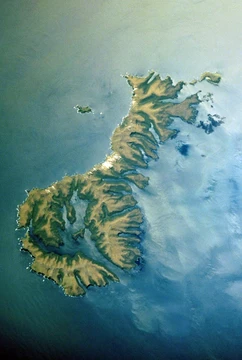
This albatross has a circumpolar pelagic range across the Southern Ocean, from the pack-ice around Antarctica (with a southernmost record at 78°S in the Ross Sea) to about 35°S, and occasionally farther north along the Humboldt Current. It breeds on several subantarctic islands—including Prince Edward Island, Marion Island, Crozet Islands, Amsterdam Island, St. Paul Island, Kerguelen Islands, Heard Island, Macquarie Island, Campbell Island, Auckland Islands, Antipodes Islands, and South Georgia—and at least on King George Island in the maritime Antarctic at 62°S. Outside the breeding season, it stays entirely at sea, foraging from the edges of Antarctic pack-ice to about 40°S. During breeding, it forages closer to its nest.
Its voice is loud, shrill, and trumpet-like. When threatened, it snaps its bill or makes a throaty “gaaaa.” Courtship involves aerial displays, formation flying, and mutual calling with pitch changes from head positioning. It uses its tail in displays more than other albatrosses do.
The species nest
- Scientific name
- Phoebetria palpebrata
- First described
- 1785 by Johann Reinhold Forster
- Average length
- 79–89 cm (31–35 in)
- Wingspan
- 183–232 cm (6.00–7.61 ft)
- Weight
- 2.5–3.7 kg (5.5–8.2 lb)
- Population estimate
- 58,000 (1998 estimate, declining)
- Conservation status
- Near threatened
Lore & Background
The light-mantled albatross is largely sooty-brown or blackish, darker on the head, with paler upperparts from the nape to the upper tail-coverts that are grey to light grey, palest on the mantle and back. Its eyes are partly encircled with thin post-orbital crescents of very short grey feathers. The bill is black with a blue sulcus and a greyish-yellow line along the lower mandible, measuring about 105 mm (4.1 in). Males and females are similar in size.
This species breeds on several subantarctic islands, including Prince Edward Island, Marion Island, Crozet Islands, Amsterdam Island, St. Paul Island, Kerguelen Islands, Heard Island, Macquarie Island, Campbell Island, Auckland Islands, Antipodes Islands, South Georgia, and at least one island in the maritime Antarctic at 62°S on King George Island. Nests are built on vegetated cliff ledges or steep slopes, sheltered from prevailing westerly winds, and consist of a low mound of peat and mud with a cupped hollow at the top. A single egg is laid around October or November, with an incubation period of 65 to 72 days. Chicks fledge in May or June after 140 to 170 days. Pairs form committed pair-bonds that may last for decades, breeding biennially and fledging a chick every five years or so.
Reader's Guide
The light-mantled albatross is significant as a representative of the smaller albatross species in the genus Phoebetria, sharing physiological traits common to Procellariiformes, such as nasal tubes called naricorns on the sides of the upper mandible, a salt gland above the nasal passage for osmotic balance, and the ability to produce stomach oil from wax esters and triglycerides for defense and nutrition. Its diet consists primarily of squid and krill, with other crustaceans, fish, and carrion also taken, and it sometimes feeds in association with pilot whales and southern right whale dolphins.
The species is classified as near threatened, with an estimated population of 58,000 (1998 estimate) that is declining. Threats include predation by giant petrels, feral cats, and rodents on breeding islands, as well as bycatch in longline fisheries and starvation from ingesting plastic marine debris. Its occurrence range spans 44,300,000 km² (17,100,000 sq mi). The light-mantled albatross is also notable for its loud, trumpet-like voice and its use of tail displays more than other albatrosses.
Did You Know?
- The light-mantled albatross was first described by Johann Reinhold Forster in 1785 based on a specimen from south of the Cape of Good Hope.
- Its plumage has been described as similar in appearance to the coloring of a Siamese cat.
- The species breeds on at least one island in the maritime Antarctic at 62°S on King George Island.
- Pairs form committed pair-bonds that may last for decades, and individuals can live to 40 years or longer.
More in Birds of subantarctic islands 1-24
Spotted an error? Know more?
This is a living reference — every entry is fact-audited, and reader corrections feed straight into our audit queue. Suggest an edit · See this site's audit record