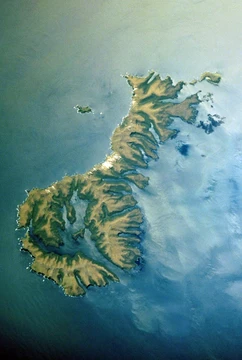
Macaroni penguin
Most numerous penguin species, known for its yellow crest.
The macaroni penguin (Eudyptes chrysolophus) is a crested penguin that lives from the Subantarctic region down to the Antarctic Peninsula. It is the most abundant penguin species, with around 18 million individuals, but its numbers have been dropping widely since the mid-1970s, earning it a vulnerable conservation status.
This species is one of eight crested penguins and is very closely linked to the royal penguin; some experts consider them the same species. Its most noticeable feature is a bright yellow crest on its forehead. The face and upper body are black, sharply separated from the white belly. Adults typically weigh about 5.5 kg (12 lb) and measure 70 cm (28 in) long. Males and females look alike, though males are a bit larger and stronger, with a bigger bill. Like all penguins, macaronis cannot fly; they have streamlined bodies and stiff, flattened flippers adapted for life at sea.
Their diet is mostly crustaceans, especially krill, plus small fish and squid. In fact, this species eats more marine life each year than any other seabird. They molt once a year, spending three to four weeks on land before heading back to the ocean. Breeding colonies can number up to 100,000 individuals, making them among the largest and densest penguin colonies. After summer breeding, they scatter across the ocean for six months; a 2009 study found that macaroni penguins from Kerguelen traveled over 10,000 km (6,200 mi) into the central Indian Ocean.
The macaroni penguin was first described from the Falkland Islands in 1837 by German naturalist Johann Friedrich von Brandt. It belongs to the genus *Eudyptes*, which comes from Ancient Greek words meaning "good diver." Its species name, *chrysolophus*, combines Greek words for "golden" and "crest." The common name "macaroni" was used by English sailors in the early 1800s, inspired by the bird’s showy yellow crest, which reminded them of the fashionable "macaroni" style of the time.
DNA evidence suggests the macaroni penguin split from its closest relative, the royal penguin, about 1.5 million years ago. Most authorities treat them as separate species, but some, like Australian ornithologists Les Christidis and Walter Boles, consider the royal penguin a subspecies. The two look very similar, except the royal penguin has a white face instead of a black one. Interbreeding with the Indo-Pacific eastern rockhopper penguin h
- scientific_name
- Eudyptes chrysolophus
- average_weight
- 5.5 kg (12 lb)
- average_length
- 70 cm (28 in)
- population
- about 18 million individuals
- conservation_status
- vulnerable
- diet
- crustaceans, mainly krill, small fish, and cephalopods
- distinctive_feature
- yellow crest on forehead
Lore & Background
The macaroni penguin was described from the Falkland Islands in 1837 by German naturalist Johann Friedrich von Brandt. Its common name was recorded from the early 19th century in the Falkland Islands, given by English sailors due to its conspicuous yellow crest, similar to the then fashionable macaroni fashion. The genus name Eudyptes is derived from Ancient Greek words meaning 'good diver', and the specific name chrysolophus means 'golden crest'.
Molecular clock evidence suggests the macaroni penguin diverged from its closest relative, the royal penguin, around 1.5 million years ago. Some authorities consider the two to be a single species, though this is not accepted by all avian taxonomy resources. Interbreeding with the Indo-Pacific eastern rockhopper penguin has been reported at Heard and Marion Islands.
Macaroni penguins moult once a year, spending three to four weeks ashore without feeding. Their breeding colonies number up to 100,000 individuals and are among the largest and densest of all penguin species. After breeding, they disperse into the oceans for six months; a 2009 study found that macaroni penguins from Kerguelen travelled over 10,000 km in the central Indian Ocean.
Reader's Guide
The macaroni penguin is significant as the most abundant penguin species, with an estimated 18 million individuals worldwide. It consumes more marine life annually than any other species of seabird, taking an estimated 9.2 million tonnes of krill per year. This makes it a key player in Southern Ocean ecosystems. However, widespread population declines have been recorded since the mid-1970s, leading to its vulnerable conservation status. The species is also notable for its distinctive yellow crest, which gave it its common name, and for its close relationship with the royal penguin, a taxonomic uncertainty that persists. Its breeding colonies, among the largest and densest of any penguin, and its long-distance migrations (over 10,000 km) highlight its adaptability and ecological importance. The macaroni penguin's diet, foraging behavior, and role as a major krill consumer underscore its impact on marine food webs.
Did You Know?
- The macaroni penguin is the most numerous penguin species, with about 18 million individuals.
- It consumes more marine life annually than any other species of seabird.
- Its common name comes from the yellow crest, which reminded English sailors of the macaroni fashion of the early 19th century.
- A 2009 study found that macaroni penguins from Kerguelen travelled over 10,000 km in the central Indian Ocean.
More in Birds of subantarctic islands 1-24
Spotted an error? Know more?
This is a living reference — every entry is fact-audited, and reader corrections feed straight into our audit queue. Suggest an edit · See this site's audit record