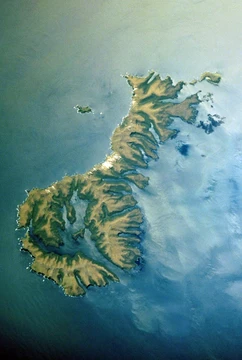
Macquarie shag
A marine cormorant restricted to subantarctic Macquarie Island.
The Macquarie shag (Leucocarbo purpurascens) is a marine cormorant that lives only on Macquarie Island, a subantarctic landmass roughly halfway between Australia and Antarctica. It belongs to the group known as blue-eyed shags. Taxonomists sometimes place it in the genus Leucocarbo or Notocarbo, though others put it in Phalacrocorax. Currently, it is generally treated as a distinct species.
This bird is found exclusively on Macquarie Island and the nearby Bishop and Clerk Islets, which lie about 33 kilometers to the south. Apart from breeding and roosting, it spends its time at sea.
In appearance, the Macquarie shag has mostly black upperparts and white underparts. Its upper cheeks and ear-coverts are black, and it has white bars on its wings. A black, recurved crest sits on its forehead, and its feet are pink. During breeding season, adults develop a pair of orange caruncles above the base of the bill, orange-brown facial skin at the base of the lower mandible, and blue eye-rings. It measures about 75 centimeters in length, with a wingspan of 110 centimeters, and weighs between 2.5 and 3.5 kilograms.
These birds are gregarious, roosting in groups that range from just a few individuals to several hundred. They are present on Macquarie Island year-round and breed annually in small to large colonies on bare rocky shores and stacks. Nest-building begins in June. The nests are truncated cones, 20 to 30 centimeters high, made from vegetation, guano, and mud. A clutch of two or three eggs is laid between mid-September and January, mostly in late September and early November, with most hatching by late December. Most chicks become independent by mid-February.
For feeding, the Macquarie shag forages locally in shallow coastal waters, primarily on benthic fish. Flocks may feed together.
In 2000, the population was estimated at about 760 breeding pairs, including 100 pairs on the Bishop and Clerk Islets. A later survey in October 2003 found 472 nesting pairs in eleven colonies on Macquarie Island itself, indicating a 30 percent decline. The taxon is listed as Vulnerable under Australia's Environment Protection and Biodiversity Conservation Act 1999, due to its small, localized population and susceptibility to fluctuations in breeding success caused by weather and food availability. Additional threats include predation of nestlings by subantarctic skuas and black
- Scientific name
- Leucocarbo purpurascens
- Length
- 75 cm
- Wingspan
- 110 cm
- Weight
- 2.5–3.5 kg
- Conservation status
- Vulnerable under Australia's EPBC Act 1999
- Breeding population (2000)
- About 760 breeding pairs
Lore & Background
The Macquarie shag is restricted to subantarctic Macquarie Island and the nearby Bishop and Clerk Islets, 33 km to the south. Its habitat is marine, apart from breeding and roosting. The birds are gregarious, roosting in groups from a few birds up to several hundred. They forage locally in shallow coastal waters, feeding primarily on benthic fish, and flocks may feed together.
Reader's Guide
The Macquarie shag is significant as a localized endemic seabird of the subantarctic region, with a small and vulnerable population. Its conservation status under Australia's Environment Protection and Biodiversity Conservation Act 1999 reflects threats from weather conditions, food availability, and predation of nestlings by Subantarctic skuas and black rats. A survey in October 2003 found 472 nesting pairs on Macquarie Island, indicating a 30% decline from an estimated 760 breeding pairs in 2000. The species breeds annually in colonies on bare rocky shores and stacks, with nest-building from June and eggs laid between mid-September and January. Its restricted range and population fluctuations underscore its vulnerability.
Did You Know?
- The Macquarie shag has largely black upperparts, white underparts, and pink feet.
- Breeding adults have orange caruncles above the base of the bill and blue eye-rings.
- The clutch consists of two or three eggs, laid mainly in late September and early November.
- The population on Macquarie Island declined by about 30% between 2000 and October 2003.
More in Birds of subantarctic islands 1-24
Spotted an error? Know more?
This is a living reference — every entry is fact-audited, and reader corrections feed straight into our audit queue. Suggest an edit · See this site's audit record