Northern giant petrel
Large predatory seabird of southern oceans, scavenger and hunter.
The northern giant petrel (Macronectes halli), also known as Hall's giant petrel, is a large, predatory seabird of the southern oceans. Its range overlaps broadly with that of the related southern giant petrel, though it occurs slightly further north. Formally described in 1912 by Australian-born ornithologist Gregory Mathews as a subspecies of the southern giant petrel, it is now considered a separate monotypic species.
- average_length
- 90 cm (35 in), range 80–95 cm (31–37 in)
- wingspan
- 150–210 cm (59–83 in)
- weight_range
- 2.5–5.8 kg (5.5–12.8 lb)
- bill_length
- 90–110 mm (3.5–4.3 in)
- breeding_age
- average 10 years
- estimated_mature_population_2001
- 17,000–21,000 birds
- conservation_status
- Least Concern (IUCN)
Lore & Background
The northern giant petrel was first formally described in 1912 by Gregory Mathews as a subspecies of the southern giant petrel, with the trinomial name Macronectes giganteus halli. The specific epithet honors Australian ornithologist Robert Hall, who described the birds breeding on the Kerguelen Islands. It is now recognized as a separate species, Macronectes halli, and is monotypic. The genus name combines Ancient Greek makros ('great') and nēktēs ('swimmer'); the name 'petrel' refers to the biblical account of Saint Peter walking on water, alluding to the birds' habit of running on the water's surface while becoming airborne.
As a tube-nosed seabird of the order Procellariiformes, it possesses tubular nostrils, a hooked maxillary unguis, and a salt gland above the nasal passage that excretes concentrated saline solution. It produces stomach oil made of wax esters and triglycerides, stored in the proventriculus, which can be sprayed as a defense or used as an energy-rich food source for chicks and adults during long flights.
The northern giant petrel averages 90 cm in length with a wingspan of 150–210 cm. Its plumage is grey-brown with lighter forehead, sides of face, and chin; the bill is pinkish yellow with a brown tip, and the eyes are grey. Juveniles are entirely dark brown and lighten with age. It can be differentiated from the southern giant petrel by the top of the bill, which on the southern species is green.
Reader's Guide
The northern giant petrel is a significant species in the Southern Ocean ecosystem, acting as both a scavenger and an apex predator. Its diet includes carrion (dead penguins and pinnipeds), fish, krill, squid, and other cephalopods, and it will follow fishing boats and cruise ships for discarded waste. It is extremely aggressive, killing other seabirds including penguin chicks and even albatross-sized birds. During breeding, males consume more carrion while females feed on pelagic sources.
Its conservation status has improved: from near threatened to least concern, with populations increasing in most locations except the Crozet Islands. This is attributed to increases in fish waste, better control of longline fishing, and more carrion from fur seals. The species is listed on CMS Appendix II and ACAP Annex 1. Future conservation plans include maintaining surveys, researching movement and migration, and continuing to reduce bycatch deaths through measures coordinated by CCAMLR, CMS, and FAO.
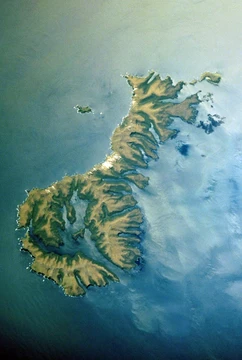
The northern giant petrel breeds six weeks earlier than the southern giant petrel, a temporal segregation that reduces interspecific competition. Sexual segregation—females making more pelagic trips than males—reduces intraspecific competition. Over 4,500 pairs nest on islands in the South Georgia group, with additional colonies on the Chatham, Kerguelen, Crozet, and Macquarie Islands.
Did You Know?
- The northern giant petrel was originally described as a subspecies of the southern giant petrel in 1912 by Gregory Mathews.
- Its specific epithet halli honors Australian ornithologist Robert Hall, who described the birds breeding on the Kerguelen Islands.
- The largest-bodied colony is in the South Georgia Islands, where males average 4.9 kg and females 3.72 kg.
- The northern giant petrel breeds six weeks earlier than the southern giant petrel, reducing competition between the two species.
More in Birds of subantarctic islands 1-24
Spotted an error? Know more?
This is a living reference — every entry is fact-audited, and reader corrections feed straight into our audit queue. Suggest an edit · See this site's audit record