Royal penguin
A crested penguin endemic to sub-Antarctic Macquarie Island.
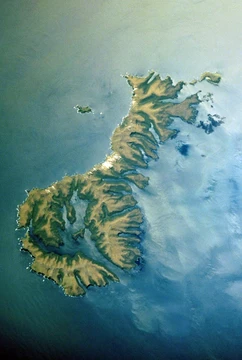
The royal penguin (Eudyptes schlegeli) lives only on Macquarie Island and nearby islets in the sub-Antarctic. The IUCN lists it as Least Concern.
This penguin belongs to the genus *Eudyptes*. German ornithologist Otto Finsch first described it in 1876, naming it after zoologist Hermann Schlegel. It is very closely related to the macaroni penguin, and the two have sometimes been considered the same species due to similar looks and behavior. Hybrids between them have been found on Macquarie Island.
Royal penguins look a lot like macaroni penguins, but their face and chin are white or pale gray instead of black. Adults have a black head, back, and flippers, with white underparts. Long yellow-orange crest feathers run from the forehead over the eyes. The bill is orange-brown with a dark tip, and the eyes are red-brown. Adults weigh between 11 and 17 pounds, though weight changes a lot during breeding. Males are usually a bit bigger and heavier. Juveniles look like adults but have duller feathers, shorter crests, and darker faces. Chicks are covered in brown down before molting into juvenile plumage.
Royal penguins breed only on Macquarie Island and the Bishop and Clerk Islets. Colonies are on beaches, coastal terraces, and vegetated slopes, sometimes over 490 feet above sea level and up to a mile inland. Nests are often near creeks or paths through thick plants. Nesting density can reach about 2.43 nests per square meter. Outside breeding and molting, they live at sea in subantarctic waters, though their full range is not well known.
Adults return to colonies from late September to October. Egg-laying is synchronized, peaking around October 20–23. Nests are shallow scrapes in sand or grass, sometimes lined with stones or pebbles. Like other crested penguins, they lay two eggs: a smaller first egg (A-egg) and a larger second one (B-egg). The first egg is often abandoned soon after the second is laid, and chicks from A-eggs survive much less often. The reason is unclear, but it is typical for crested penguins.
Incubation lasts about 35 days, with both parents taking turns of up to 10–14 days. After hatching, males guard the chick for 2–3 weeks while females feed at sea. If food trips are delayed too long, chicks may die. After the guard stage, chicks form large crèches in January for warmth and protection while both parents feed them several times a day. Fled
- Scientific name
- Eudyptes schlegeli
- First described by
- Otto Finsch in 1876
- Named in honor of
- Hermann Schlegel
- IUCN status
- Least Concern
- Endemic to
- Macquarie Island and Bishop and Clerk Islets
- Typical adult weight
- 11–17 lb
- Breeding population
- 850,000 pairs
Lore & Background
The royal penguin was first described by German ornithologist Otto Finsch in 1876 and named after German zoologist Hermann Schlegel. It belongs to the genus Eudyptes and is very closely related to the macaroni penguin (Eudyptes chrysolophus), with which it has sometimes been treated as conspecific due to similar morphology and behavior. Hybridization between the two species has been recorded on Macquarie Island.
Adults have a black head, back, and flippers, white underparts, and long yellow-orange crest feathers extending from the forehead over the eyes. They differ from macaroni penguins primarily in having a white or pale grey face and chin. Males are generally slightly larger and heavier than females. Juveniles have duller plumage, shorter crests, and darker facial coloration, while chicks are covered in brown down.
Royal penguins breed colonially on beaches, coastal terraces, and vegetated slopes, sometimes up to 1 mile inland. They lay a two-egg clutch, with the first egg often abandoned. Incubation lasts about 35 days, shared by both sexes. After hatching, males guard the chick for 2–3 weeks while females forage. Chicks form crèches in January and fledge at around 65 days of age.
Reader's Guide
The royal penguin is significant as a species endemic to a single island group, Macquarie Island and its adjacent islets, making it highly localized in distribution. Its close relationship and occasional hybridization with the macaroni penguin provide insight into speciation and evolutionary biology among crested penguins. Historically, royal penguins were heavily hunted for oil between 1870 and 1919, with an average of 150,000 penguins (both royal and king) taken annually. At the peak in 1905, a processing plant handled 2,000 penguins at a time, each yielding about half a litre of oil. This exploitation drastically reduced populations from an estimated three million (both species) before hunting to 850,000 pairs after hunting ceased. Modern threats include introduced predators such as rats, discarded plastic, pollution, and decreased food supply due to commercial fishing. Despite these pressures, the IUCN classifies the royal penguin as Least Concern, indicating a relatively stable current population.
Did You Know?
- The royal penguin was named in honor of German zoologist Hermann Schlegel.
- Hybridization between royal and macaroni penguins has been recorded on Macquarie Island.
- Historically, between 1870 and 1919, an average of 150,000 royal and king penguins were taken each year for oil.
- Royal penguins lay a two-egg clutch, but the first egg is often abandoned shortly before or after the second is laid.
More in Birds of subantarctic islands 1-24
Spotted an error? Know more?
This is a living reference — every entry is fact-audited, and reader corrections feed straight into our audit queue. Suggest an edit · See this site's audit record