Snowy albatross
Largest living bird by wingspan, circumpolar in the Southern Ocean.
The snowy albatross (Diomedea exulans), also known as the wandering albatross, white-winged albatross, or goonie, is a large seabird from the family Diomedeidae. It has a circumpolar range in the Southern Ocean and is the largest species of albatross, possessing the greatest known wingspan of any living bird. It was long considered the same species as the Tristan albatross and the Antipodean albatross, and together with the Amsterdam albatross forms the wandering albatross species complex, which some refer to as 'snowy.'
- Scientific name
- Diomedea exulans
- Family
- Diomedeidae
- Maximum wingspan
- up to 3.7 m (12 ft)
- Body length
- 107 to 135 cm (3 ft 6 in to 4 ft 5 in)
- Adult weight range
- 5.9 to 12.7 kg (13 to 28 lb)
- Conservation status
- Vulnerable (IUCN)
- Breeding range
- 1,900 km² (730 sq mi)
Lore & Background
The snowy albatross was first described as Diomedea exulans by Carl Linnaeus in 1758, based on a specimen from the Cape of Good Hope. Its genus name refers to Diomedes from Greek mythology, whose companions turned to birds, and its species name means 'exile' or 'wanderer,' referencing its extensive flights. The type locality has been restricted to South Georgia. Some experts recognize four subspecies of D. exulans, which they elevate to species status, using 'wandering albatross' for the complex that includes D. antipodensis, D. dabbenena, D. exulans, and D. a. gibsoni.
Plumage varies with age: juveniles are chocolate brown and become whiter as they age. Adults have white bodies with white and black wings; males have whiter wings than females. The snowy albatross is the whitest of the wandering albatross species complex. Its large bill and feet are pink. It has a salt gland above the nasal passage that helps desalinate its body, excreting a high saline solution that may cause a pink-yellow stain on some animals' necks.
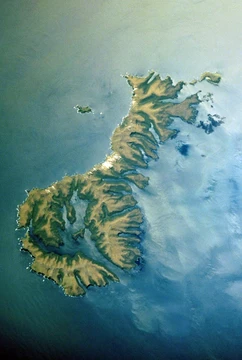
The snowy albatross breeds on South Georgia Island, Crozet Islands, Kerguelen Islands, Prince Edward Islands, and Macquarie Island. It ranges in all southern oceans from 28° to 60°. Some individuals circumnavigate the Southern Ocean three times in one year, covering more than 120,000 km (75,000 mi). It spends most of its life in flight, landing only to breed and feed. One banded bird traveled 6,000 km (3,700 mi) in twelve days.
Reader's Guide
The snowy albatross is significant as the bird with the longest wingspan of any living species, reaching up to 3.7 m (12 ft). Its ability to remain aloft without flapping for hours—traveling 22 m for every meter of drop—demonstrates remarkable adaptation to oceanic flight. It is one of the most far-ranging birds, with individuals circumnavigating the Southern Ocean multiple times annually. Its taxonomic history is complex, having been long conflated with other albatross species now considered distinct. The species is vulnerable, with adult mortality of 5% to 7.8% per year as of 2003. The biggest threats are longline fishing bycatch and pollution from plastics and abandoned fishing hooks. Conservation measures by the CCAMLR have reduced bycatch around South Georgia by 99%, and other regional commissions are taking similar steps. The Prince Edward Islands are a nature preserve. The snowy albatross has cultural resonance through Coleridge's The Rime of the Ancient Mariner, where killing one is seen as bad luck, giving rise to the metaphor 'an albatross around his neck.' Māori used albatross wing bones for flutes, needles, tattooing chisels, and fish hooks.
Did You Know?
- The snowy albatross has the greatest known wingspan of any living bird, reaching up to 3.7 m (12 ft).
- Some individuals circumnavigate the Southern Ocean three times in one year, covering more than 120,000 km (75,000 mi).
- Its incubation period of about 11 weeks is among the longest of any bird.
- The species was first described by Carl Linnaeus in 1758 based on a specimen from the Cape of Good Hope.
More in Birds of subantarctic islands 1-24
Spotted an error? Know more?
This is a living reference — every entry is fact-audited, and reader corrections feed straight into our audit queue. Suggest an edit · See this site's audit record