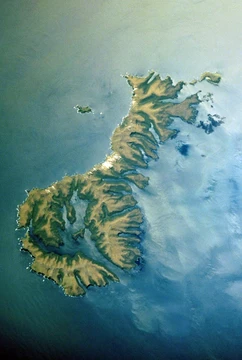
Sooty albatross
Endangered seabird with sooty plumage and biennial breeding.
The sooty albatross (Phoebetria fusca), sometimes called the Quaker by sailors, is a medium-sized seabird in the albatross family Diomedeidae. Its plumage is a sooty-brown or sooty-black, with the head and sometimes the tail being darker than the rest of the body. A white ring encircles most of the eye, and a yellow-to-orange line runs along the lower jaw of its otherwise glossy black beak. Adults measure about 85 cm (33 in) from head to tail, have a wingspan of 2 m (6.6 ft), and weigh around 2.5 kg (5.5 lbs), with males slightly heavier than females. Juveniles look nearly identical to adults once they lose their down.
This species lives in the southern Atlantic Ocean, the southern Indian Ocean, and the Southern Ocean, ranging from roughly 20°S to 65°S and between about 160°E and 75°W. It is not found in the South Pacific between Australia and South America. It nests on islands in the southern Atlantic (Gough Island and the Tristan da Cunha group) and the southern Indian Ocean (Prince Edward Island, Marion Island, the Crozet Islands, Amsterdam Island, and the Kerguelen Islands). Foraging occurs over deep ocean, with breeding adults staying within about 600 km (370 mi) of their nest sites, non-breeding adults ranging more widely but staying in their native oceans, and juveniles mostly confined to subtropical waters.
The sooty albatross spends most of its non-breeding life at sea. It feeds mainly by surface-seizing, taking squid, fish, other seabirds, crustaceans, and carrion. It does not deep-dive but scavenges floating prey, especially squid. The diet’s makeup varies by location, prey abundance, and season. It forages during the day, with peak activity about three hours before dusk, and typically feeds alone, though it sometimes associates with yellow-nosed mollymawks and whales.
Breeding happens every other year, unless a pair fails to raise a chick, in which case they may try again the next year. The season runs from June to May, and unlike some albatrosses, they do not replace a lost egg. Pairs form life-long bonds and return to the same nesting spot each season. Nests are built on cliff ledges or steep slopes using grass, mud, and moss, with a central indent. Colonies usually contain 5 to 60 nests, though solitary pairs occur. Birds return to breeding grounds from mid-July to early September. They are shy and defend their nests with threat displays. T
- scientific_name
- Phoebetria fusca
- family
- Diomedeidae
- average_length
- 85 cm (33 in)
- wingspan
- 2 m (6.6 ft)
- average_mass
- 2.5 kg (5.5 lbs)
- conservation_status
- Endangered
- estimated_mature_population
- 22,724–27,968
Lore & Background
The sooty albatross belongs to the genus Phoebetria, which includes two species: P. palpebrata and P. fusca. The two were discovered separately but were not placed in the same genus until 1913, later confirmed by cytochrome-b gene sequencing. This species is monotypic with no subspecies. It is part of the Diomedeidae family, within the order Procellariiformes, which includes tube-nosed seabirds such as shearwaters, fulmars, and petrels.
This albatross nests on islands in the southern Atlantic Ocean (Gough Island and the Tristan da Cunha group) and the southern Indian Ocean (Prince Edward Island, Marion Island, the Crozet Islands, Amsterdam Island, and the Kerguelen Islands). It forages over deep ocean, with breeding adults staying within 600 km (370 mi) of their nesting sites, while non-breeding adults have a broader range. Juveniles tend to be confined to subtropical waters.
The sooty albatross is a biennial breeder, returning to its breeding grounds in mid-July to early September. Pairs build nests on ledges of coastal and inland cliffs, using grass, mud, and moss. They lay a single egg between mid-September and the end of October, incubating it for about 70 days. Parents brood the chick for roughly three months, and the chick fledges by the end of May.
Reader's Guide
The sooty albatross is significant as an endangered species whose population has declined by 60% over the past three generations (about 90 years), though the rate of decline has slowed recently. Its conservation highlights the threats faced by seabirds from both natural and anthropogenic forces, including predation of chicks by giant petrels and mice, infectious diseases like avian cholera, disturbance from introduced animals and fires, pollution from plastics and chemicals, and long-line fishing by commercial and illegal vessels. Conservation efforts include the use of fishing techniques designed to reduce seabird bycatch, preservation of breeding areas by Australia, and protection on Tristan da Cunha, Gough Island (a nature preserve and World Heritage Site), and Prince Edward Island (a nature reserve). Scientists recommend frequent population surveys at breeding sites and further examination of the correlation between foraging areas and long-line fisheries. The sooty albatross's life history—biennial breeding, life-long pair bonds, and synchronized flight patterns—makes it a distinctive species within the albatross family.
Did You Know?
- The sooty albatross is also known to sailors as the Quaker.
- It has a white ring around almost the entire eye, excluding the inner corner.
- The species is monotypic with no subspecies.
- The sooty albatross feeds almost exclusively by surface-seizing, requiring little to no submersion.
More in Birds of subantarctic islands 1-24
Spotted an error? Know more?
This is a living reference — every entry is fact-audited, and reader corrections feed straight into our audit queue. Suggest an edit · See this site's audit record