Sooty shearwater
A dark-plumaged seabird known for epic migrations and Māori harvest.
The sooty shearwater (Ardenna grisea) is a medium-large seabird belonging to the Procellariidae family. In New Zealand, it is called tītī in Māori, and Māori people harvest it for muttonbird, along with the wedge-tailed shearwater and the Australian short-tailed shearwater.
German naturalist Johann Friedrich Gmelin formally described the species in 1789, giving it the scientific name Procellaria grisea. James Cook had briefly mentioned the bird in 1777 during his second Pacific voyage, but without a valid scientific name, and English ornithologist John Latham described a museum specimen in 1785 without naming it. Today, it is placed in the genus Ardenna, which Ludwig Reichenbach described in 1853. The genus name comes from Italian naturalist Ulisse Aldrovandi’s 1603 reference to a seabird, while the species name grisea is medieval Latin for “grey.” No subspecies are recognized. The sooty shearwater appears closely related to the great shearwater and the short-tailed shearwater—all blunt-tailed, black-billed species—though exact relationships remain unclear. These three larger shearwaters were moved into Ardenna based on mitochondrial DNA analysis.
The bird measures 40–51 cm in length with a wingspan of 94–110 cm. It flies with a typical shearing motion, dipping side to side on stiff wings with few beats, wingtips nearly touching the water. Its flight is powerful and direct, with wings held straight, resembling a very small albatross. Its dark plumage gives it its name; in poor light it looks all black, but in good light it appears dark chocolate-brown with a silvery strip along the center of the underwing. At night on breeding grounds, it makes loud coos and croaks, but at sea it is usually silent, though it may call when competing for food in large groups. In the Atlantic, it is the only all-dark large shearwater, though at long range it can be confused with the smaller, paler Balearic shearwater, which lacks the pale underwing stripe. In the Pacific, other all-dark large shearwaters occur, and the short-tailed shearwater is nearly impossible to distinguish at a distance.
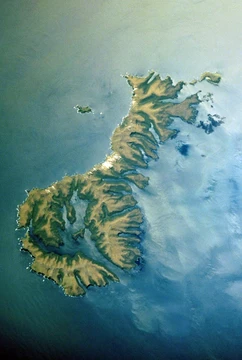
Sooty shearwaters breed on small islands in two main populations: one in the south Pacific around southeast Australia, New Zealand, the Auckland Islands, and Phillip Island off Norfolk Island; the other in the south Atlantic on the Falkland Islands, Tierra del Fuego, and Tristan da Cunh
- Scientific name
- Ardenna grisea
- Length
- 40–51 cm (16–20 in)
- Wingspan
- 94–110 cm (37–43 in)
- Conservation status
- Near threatened (IUCN)
- Breeding range
- South Pacific and South Atlantic islands
- Known for
- Long-distance migration, Māori harvest, inspiration for Hitchcock's The Birds
Lore & Background
The sooty shearwater was formally described in 1789 by Johann Friedrich Gmelin under the name Procellaria grisea, though James Cook had briefly described it in 1777. It is now placed in the genus Ardenna, named by Ludwig Reichenbach in 1853. The species is monotypic, with no recognized subspecies. It is closely related to the great shearwater and the short-tailed shearwater, all blunt-tailed, black-billed species, though its precise relationships are obscure.
Sooty shearwaters breed on small islands in the south Pacific and south Atlantic Oceans, including around New Zealand, the Falkland Islands, and Tristan da Cunha. They are spectacular long-distance migrants, following a circular route that can cover 74,000 km in a year. They feed on fish and squid, diving up to 68 m deep, and often follow whales or fishing boats for food.
In New Zealand, about 250,000 chicks are harvested annually by the Māori for muttonbird. The species has declined in recent decades and is classified as near threatened. In 1961, thousands of crazed sooty shearwaters appeared on the shores of North Monterey Bay, California, an event that helped inspire Alfred Hitchcock's 1963 film The Birds.
Reader's Guide
The sooty shearwater is significant both ecologically and culturally. Ecologically, it is one of the most extreme long-distance migrants in the bird world, with individuals from New Zealand traveling up to 74,000 km per year, averaging over 500 km per day. Its migrations connect the Southern and Northern Hemispheres, and it plays a role in marine food webs as a predator of fish and squid. The species also serves as an indicator of ocean health, as seen in the 1961 Monterey Bay poisoning event linked to toxic algae, which may have been exacerbated by human pollution.
Culturally, the sooty shearwater is central to Māori tradition in New Zealand, where it is known as tītī and harvested for muttonbird. This practice has been ongoing for generations, though climate change is now impacting the harvest. The species also gained notoriety when a mass stranding event in 1961 inspired Alfred Hitchcock's classic thriller The Birds, highlighting the potential for nature to disrupt human life. Its near-threatened status underscores the need for conservation efforts to protect its breeding colonies and migratory routes.
Did You Know?
- The sooty shearwater was briefly described by James Cook in 1777 but not given a scientific name until 1789 by Johann Friedrich Gmelin.
- In New Zealand, about 250,000 chicks are harvested each year by Māori for muttonbird.
- A mass stranding of sooty shearwaters in Monterey Bay in 1961 helped inspire Alfred Hitchcock's film The Birds.
- Tagging experiments show that birds breeding in New Zealand may travel 74,000 km in a year, averaging more than 500 km per day.
More in Birds of subantarctic islands 1-24
Spotted an error? Know more?
This is a living reference — every entry is fact-audited, and reader corrections feed straight into our audit queue. Suggest an edit · See this site's audit record