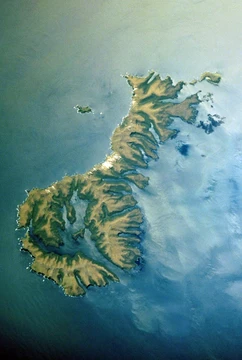
South Georgia diving petrel
A small diving petrel of southern oceans.
The South Georgia diving petrel (Pelecanoides georgicus) is one of five closely related, small diving petrels that resemble auks and inhabit the southern oceans. Its range includes the South Atlantic, islands in the southern Indian Ocean, and parts of southeastern Australia. This species was first described in 1916 by American ornithologist Robert Cushman Murphy and zoologist Francis Harper, who named it after the South Georgia islands, where they first identified it.
- Scientific name
- Pelecanoides georgicus
- Length
- 180–220 mm (7.1–8.7 in)
- Weight
- 90–150 g (3.2–5.3 oz)
- Breeding season
- October–February
- Incubation period
- 44–52 days
- Fledging period
- 43–60 days
- Maximum dive depth
- 48.6 m (159 ft)
Lore & Background
The South Georgia diving petrel nests in colonies on Subantarctic islands, breeding on South Georgia, the Prince Edward Islands, Crozet Islands, Kerguelen Islands, and Heard Island and McDonald Islands. It disperses to surrounding seas, with vagrants recorded in the Falkland Islands and Australia. Nesting burrows, typically 1.5 m long, are usually built on scree slopes above the vegetation line, occasionally on flat land.
Reader's Guide
The South Georgia diving petrel is significant as one of five very similar diving petrel species, noted for being the most proficient divers of the order Procellariformes. Its diving capabilities have been recorded to 48.6 m, with most dives between 20.4 and 24.4 m. It feeds primarily on planktonic crustaceans, particularly krill, as well as small fish and young cephalopods. Threats include skuas, cats, and rats. A unique New Zealand population is now considered a separate species, the Whenua Hou diving petrel.
Did You Know?
- The South Georgia diving petrel was described in 1916 by Robert Cushman Murphy and Francis Harper.
- Its specific name georgicus is derived from the South Georgia islands.
- It is almost indistinguishable from the common diving petrel except by inner web primary feather color and bill size.
- Dive depths have been recorded to 48.6 m, with most in the range of 20.4 to 24.4 m.
More in Birds of subantarctic islands 1-24
Spotted an error? Know more?
This is a living reference — every entry is fact-audited, and reader corrections feed straight into our audit queue. Suggest an edit · See this site's audit record