South Georgia pintail
A mottled brown pintail endemic to subantarctic South Georgia.
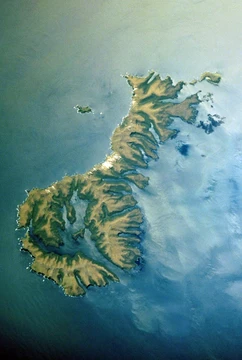
The South Georgia pintail (Anas georgica georgica), sometimes incorrectly called the South Georgian teal, is the nominate subspecies of the yellow-billed pintail. This duck is found only on the large subantarctic island of South Georgia and its surrounding archipelago, and occasionally turns up on the South Sandwich Islands. James Cook recorded it during the first known landing on South Georgia in January 1775, and it was once treated as a distinct species.
**Taxonomy** For a long time, this duck was considered a separate taxon, and its closest relatives were thought to be teals. Robert Cushman Murphy was the first to show it is actually a pintail, related to the yellow-billed pintails of South America (now split into the Chilean pintail and the extinct Niceforo's pintail). Murphy kept it as a full species because of its isolated range and because it has 16 tail feathers (rectrices) instead of the typical 14. However, the number of tail feathers varies among ducks—many mainland pintails also have 16, and a few South Georgia pintails have 18—so the three are now usually grouped together as the yellow-billed pintail.
**Description** This is a small, mottled, mostly brown pintail. It is smaller and stockier than the mainland subspecies, with darker, more uniform plumage. It has a reddish crown, light brown cheeks and throat, dark grey underwings, and a pointed tail. The back, breast, and flanks are scalloped with buff; the underparts are buffy white with brown mottling. The bill is yellow with a blue and black line along the top and tip, and the feet are greenish-grey. Downy chicks are dark brown with yellowish buff markings. Unlike other pintails, males and females look similar, though males are larger. The ducks range from 45 to 65 cm in length; males weigh 610 to 660 g, females 460 to 610 g. Minor differences: the male has uniformly brownish-grey upperwing coverts and a glossy greenish-black speculum, while the female has mottled upperwing coverts and a dull brown speculum.
**Identification** The only species it might be confused with is the yellow-billed teal, which self-introduced to South Georgia and first bred there in 1971. That teal also has a yellow bill but is smaller and more compact, with less spotting on the flanks, a buff bar in front of the speculum, a white stripe on the underwing, and a shorter, less pointed tail.
**Distribution and habita
- Scientific name
- Anas georgica georgica
- Subspecies of
- Yellow-billed pintail (Anas georgica)
- Endemic to
- South Georgia and its archipelago
- Length
- 45 to 65 cm
- Male weight
- 610 to 660 g
- Female weight
- 460 to 610 g
- Population estimate
- Exceeds 2,000
Lore & Background
The South Georgia pintail is a distinctive small, mottled, predominantly brown duck, smaller and stockier than mainland relatives. It has a reddish crown, light brown cheeks and throat, dark grey underwings, and a pointed tail. The bill is yellow with a blue and black line on the culmen and tip. Unlike other pintails, males and females appear similar, though males are larger. The downy chick is dark brown with yellowish buff markings.
Reader's Guide
The South Georgia pintail is significant as an endemic subspecies of a subantarctic island, illustrating adaptation to a harsh environment. Its history reflects human impact: intensive hunting by whalers and sealers in the late 19th and early 20th centuries reduced its population considerably, but numbers recovered after whaling was abandoned. The duck's behavior—such as hiding in tussock grass rather than flying when approached—suggests it evolved without natural predators before human arrival. Its feeding habits include scavenging at seal carcasses alongside giant petrels, and it breeds in solitary pairs with a long season. The species is now considered about as abundant as the available habitat allows, with a population exceeding 2,000.
Did You Know?
- The South Georgia pintail was among the birds noted by James Cook in January 1775.
- It has 16 rectrices (tail feathers), though some individuals have 18, while mainland pintails often have 14.
- The duck's only natural enemy is the skua.
- Males assist in raising the young, and pairs mate for life.
More in Birds of subantarctic islands 1-24
Spotted an error? Know more?
This is a living reference — every entry is fact-audited, and reader corrections feed straight into our audit queue. Suggest an edit · See this site's audit record